Almost nobody orders custom golf tees worrying about the rulebook, and for most events that instinct is correct. But if you are buying tees for a club championship, an association event, or anything where scores will count, it is worth knowing that the Rules of Golf actually regulate the tee itself — not just how you use it. The good news is that a standard printed tee is conforming by default, and it takes a genuinely unusual design to run afoul of the rules. Here is what the Rules say, when it matters, and how to make sure a bulk order is safe either way.
When the Rules actually apply to your tees
The Rules of Golf govern play in formal competition and in any round a player intends to post for handicap purposes. A charity scramble, a corporate outing, or a company fun day is usually not played under strict Rules, and in that setting nobody is going to disqualify a foursome over their tees. The moment scores matter — a member-guest with a real trophy, a club championship, a state or regional association event — the equipment has to conform, and that includes the humble tee. So the practical test is simple: if the event feeds a handicap or crowns a champion, buy conforming tees; if it is a social outing, you have more latitude, though there is rarely a reason not to stay conforming anyway.
The one number that matters: four inches
The headline requirement is length. Under the Equipment Rules that sit behind Rule 6.2b, a tee must not be longer than 4 inches, which is 101.6 millimeters. That is the entire length limit, and it is generous. The tees you actually buy in bulk cluster well below it: a 2.75-inch tee is the common all-round size, a 3.25-inch tee is the popular choice for teeing a modern driver, and shorter 2.125-inch tees suit irons and par-3 shots. Even the tallest standard driver tee leaves the better part of an inch of headroom under the cap.
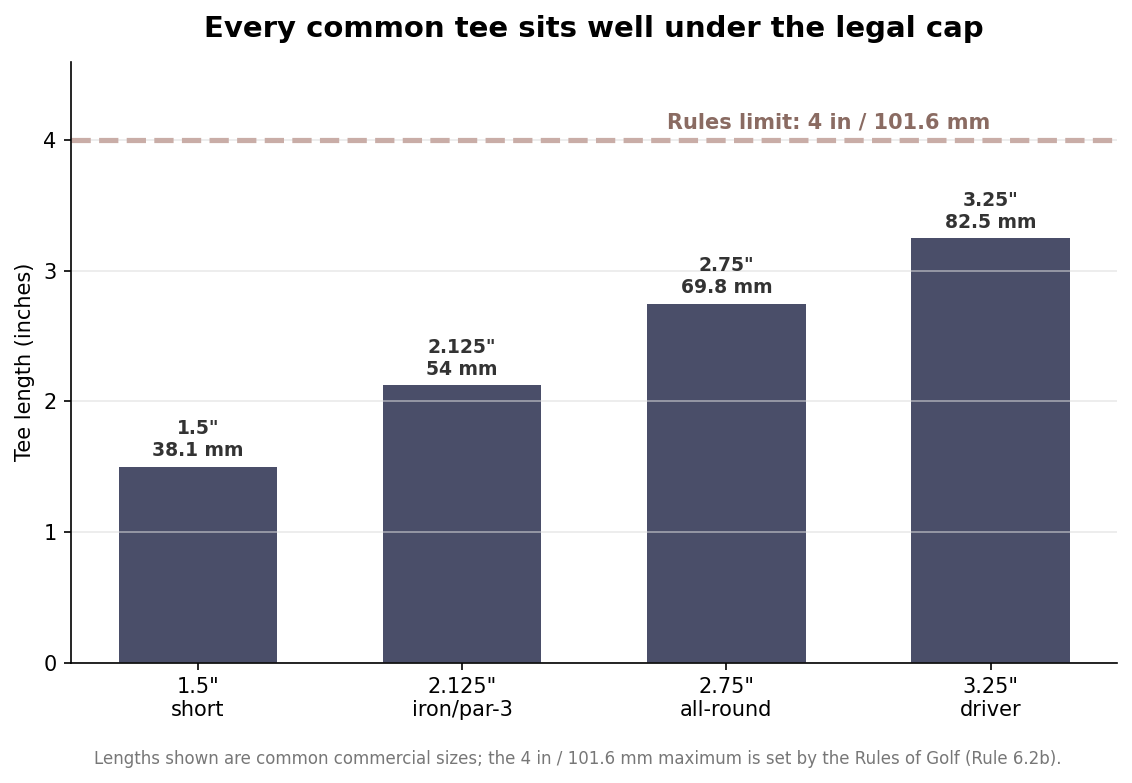
The only length trap is the occasional novelty “power” or extra-long tee sold on the promise of more height. Anything marketed as taller than four inches is non-conforming on its face, and it is the one length-related mistake a buyer can make without realizing it. Stick to standard sizes and length is a non-issue.
The prohibitions that catch novelty tees
Length is the easy part. The Rules add three design prohibitions that matter far more for anyone tempted by a gimmick. A tee must not be designed or manufactured in a way that could indicate the line of play, must not unduly influence the movement of the ball, and must not otherwise assist the player in making a stroke or in their play. In plain terms, a tee cannot double as an aiming aid or a swing aid.
This is what makes certain novelty tees non-conforming. A tee molded with an arrow or a pointer that a player lines up toward the target is indicating the line of play. A tee with an exaggerated cup or fins engineered to launch the ball is straying into unduly influencing its movement. Reduced-friction and brush-style tees are generally accepted because they do not meaningfully change ball flight, but the closer a design gets to promising free distance or built-in alignment, the closer it gets to the line. For a bulk buyer the lesson is that a conventional tee — wood, bamboo, or plastic, with a normal cup and a printed logo — satisfies all three prohibitions without you having to think about it. The risk lives entirely in the specialty shapes.
Reading a spec sheet in both units
One reason length confusion creeps in is that tees are quoted in inches by American suppliers and in millimeters by many overseas factories, and a spec sheet may mix both. The conversion is fixed at 25.4 millimeters per inch, so the four-inch cap is exactly 101.6 millimeters, a 3.25-inch driver tee is about 82.5 millimeters, and a 2.75-inch tee is roughly 69.8 millimeters. If a quote lists a length in millimeters, converting it back and checking it against 101.6 is a five-second way to confirm conformance before you approve a sample.
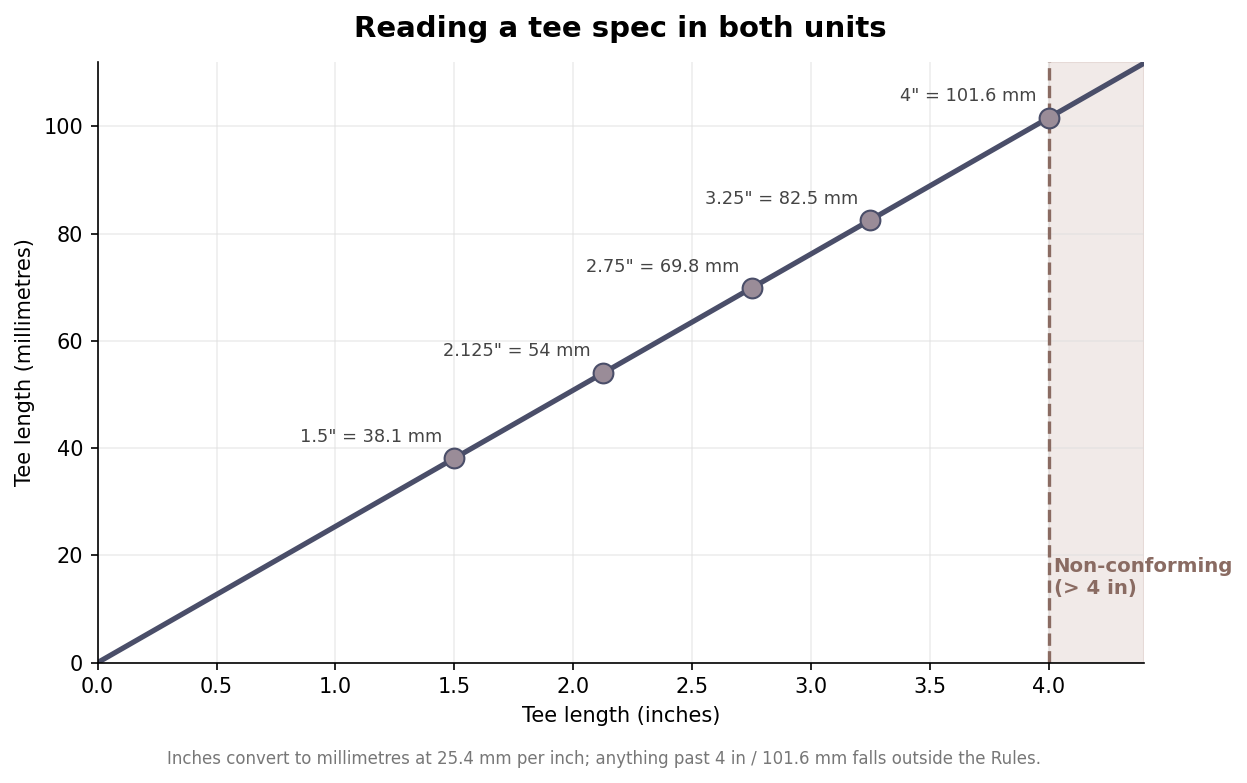
Keeping both units in view also helps when you are matching a custom order to tees a golfer already likes, since the length they name will often be in whichever unit their current brand prints on the pack. As long as the number lands below 101.6 millimeters, the tee clears the length rule, and every standard size does so comfortably.
Ordering tees that are safe either way
The simplest way to stay out of trouble is to default to conventional tees for anything that might be played competitively, and to reserve novelty shapes for social giveaways where the Rules are not in force. A plain wood or bamboo tee in a 2.75-inch or 3.25-inch length, printed with your logo, is conforming, familiar to every golfer, and cheap to produce at volume — which is exactly why it is the workhorse of the custom-tee business. If a client specifically wants an unusual design, it is worth asking what event it is for before you order, because a tee that is perfect for a branded booth handout could quietly disqualify a player who tees it up in a counting round. Length under four inches, a normal cup, and no built-in aiming or launching features is the whole checklist, and standard tees pass it every time. Get those basics right and the rulebook becomes one less thing to think about when you place the order.