Most people ordering custom golf tees for an outing pick a length, choose wood or bamboo, and stop there. But there is a second decision that changes how the tee plays and how your logo reads on it: the shape of the tee itself. Standard spikes, castle (step) tees, brush tees, and stubby par-3 tees are all different tools, and for a branded bulk order the design you choose affects consistency for your players, how many you go through, and how much clean surface you have to print on. Here is how the common designs differ and how to spec them for an event.
The standard tee still fits almost everyone
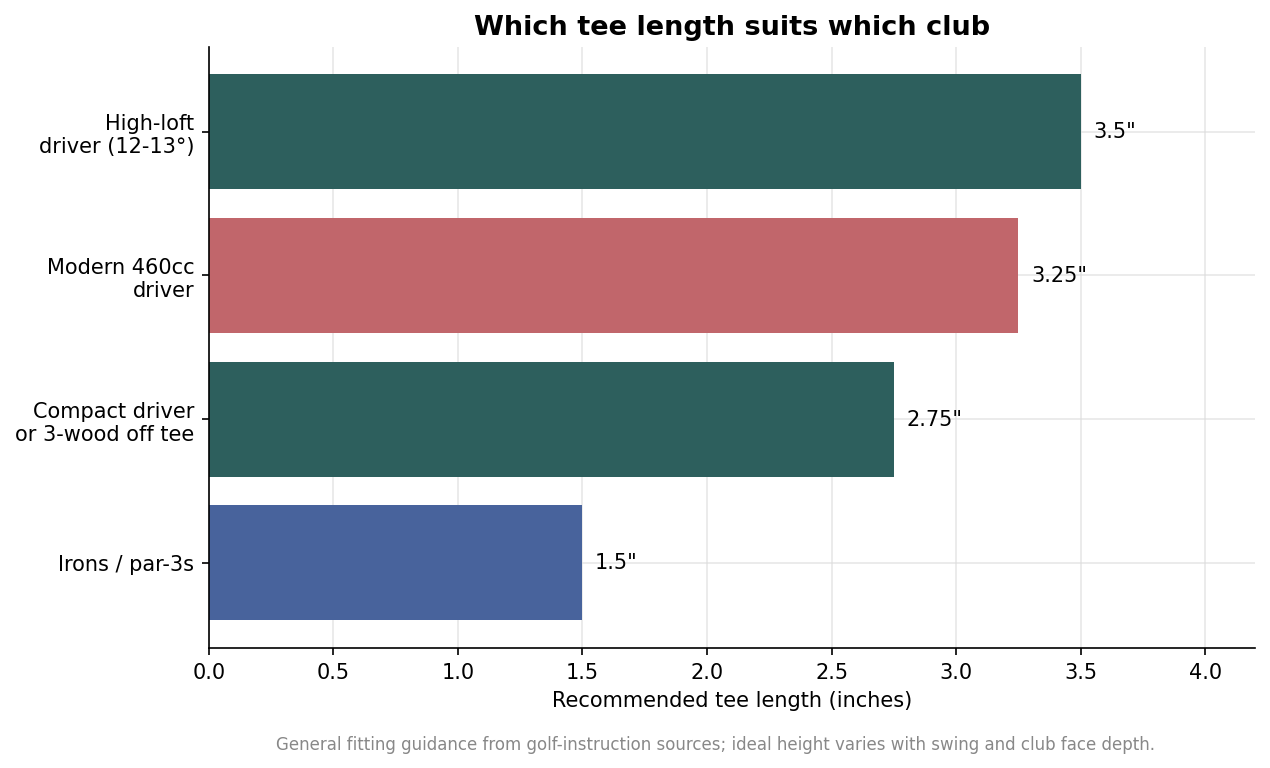
The classic tapered spike is the default for good reasons. It suits every club, it is the cheapest to produce in volume, and its long smooth shank is the easiest surface to imprint a logo or event name on. For a tournament giveaway where players bring mixed skill levels and swing every club in the bag, a standard tee in a versatile length is the safe call. Modern 460cc drivers generally want a longer tee, around 3.25 inches, so the ball’s equator sits at the top edge of the face; fairway woods and older compact drivers sit lower at about 2.75 inches; and irons on par-3s use a short 1.5-inch tee pushed nearly flush. If you are buying one length for a whole field, 3.25 inches covers the driver-heavy majority while still working shorter. The chart below maps length to club.
Castle and step tees fix inconsistent height
A castle tee — sometimes called a step tee — solves a real problem: teeing the ball at the same height every time. Instead of guessing how deep to push a spike into turf that ranges from soft to rock-hard, the golfer pushes the tee down until the raised collar or “steps” stop it at a fixed height. That repeatability is the selling point; independent coverage of these designs frames the benefit as tighter launch consistency rather than raw distance. For a corporate scramble full of occasional golfers, a castle tee can genuinely make the first shot less of a lottery. The trade-offs are cost and print area: they run a little more per unit than a plain spike, and the stepped or collared section eats into the smooth shank, so your imprint window is smaller. If you go this route, confirm the printable zone before approving artwork.
Brush and low-friction tees chase a marginal gain
Brush tees replace the solid cup with bristles, and “zero-friction” designs use a pronged or pared-down top, both aiming to reduce contact between tee and ball at impact. The theory is less resistance, so slightly more energy transfers to the ball. Be honest with your expectations here: testing generally puts the distance benefit at under two yards, which no weekend player will notice. Where these designs earn their place is novelty and talking-point value — they look different in a goodie bag and signal that some thought went into the gift. For branding, the bristle versions offer very little printable hard surface, so the logo usually lives on the plastic base rather than the shank. Order these as a premium or novelty tier, not as your bulk workhorse.
Short and par-3 tees for a specific hole
The 1.5-inch tee is a niche but useful item, especially for par-3 course events or a specific hole sponsorship. It positions an iron shot just off the turf without the ball ballooning, and because it is small and cheap it is easy to hand out in quantity. It is a poor choice as a general giveaway because it will not tee a driver, so treat it as a supplement to a standard tee rather than a replacement. If your event has a par-3 contest or a hole-in-one hole, a small run of branded short tees dedicated to that station is a nice touch that most organizers overlook.
Keep it conforming, and spec the print early
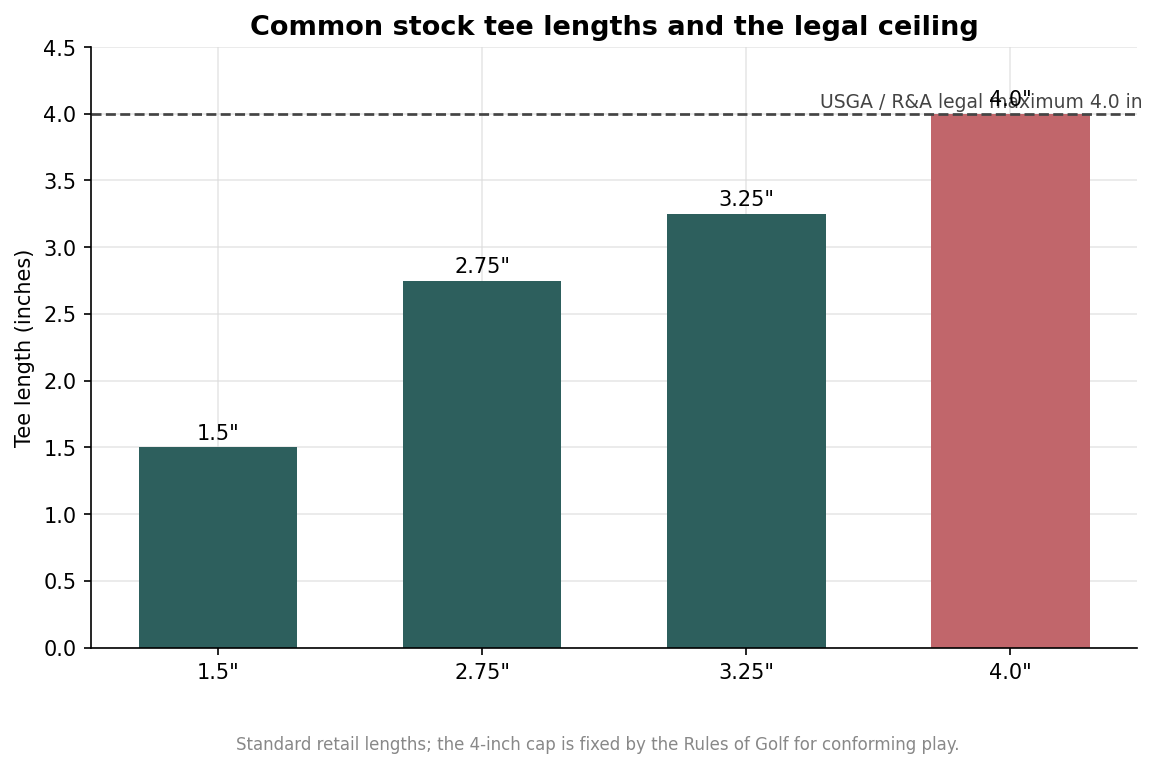
Whatever design you choose, the length is capped: the USGA and R&A set a maximum legal tee length of 4 inches for conforming play. Any stock length at or under that is fine for a real tournament, and the common retail sizes — 1.5, 2.75, 3.25, and 4.0 inches — all sit within the rule, as the chart below shows.
The practical steps for a clean bulk order are the same across designs: pick the length that matches the majority of your field, choose the design tier deliberately (standard for the field, a premium design only where it adds something), and lock the imprint area against the specific tee before art goes to production, because a step, collar, or brush cup shrinks the usable surface. Nail those and a six-millimetre-wide giveaway ends up doing real work — in a player’s hand on every hole, and in their bag long after the event.