Tee length is the specification golfers ignore right up until it costs them. Reach into a bag and most players pull whatever tee is nearest, then wonder why the driver feels inconsistent or the iron shot off the tee jumps. The physical length of the peg sets the ceiling on how high the ball can sit, and modern drivers changed what that ceiling needs to be. For anyone buying tees in quantity for an event, a club, or a promotional run, length is also the variable that decides whether one box serves the whole field or half of it goes unused.
The four standard lengths
Tees are sold in a handful of nominal sizes, and knowing what each is for removes most of the guesswork. The 1.5-inch short tee is for irons and par-3 shots, pushed nearly flush so only a dimple or two of the ball clears the turf. The 2.75-inch tee is the versatile middle: it suits fairway woods and hybrids off the tee, older or compact driver heads, and doubles as a passable all-rounder with minor height tweaks. The 3.25-inch tee is the modern default, built for today’s large driver heads and the length most golfers should reach for on a par 4 or 5. The 4-inch extra-long tee is a specialist size for high-loft drivers and slower swing speeds, roughly under 72 miles per hour, where teeing the ball higher helps launch.
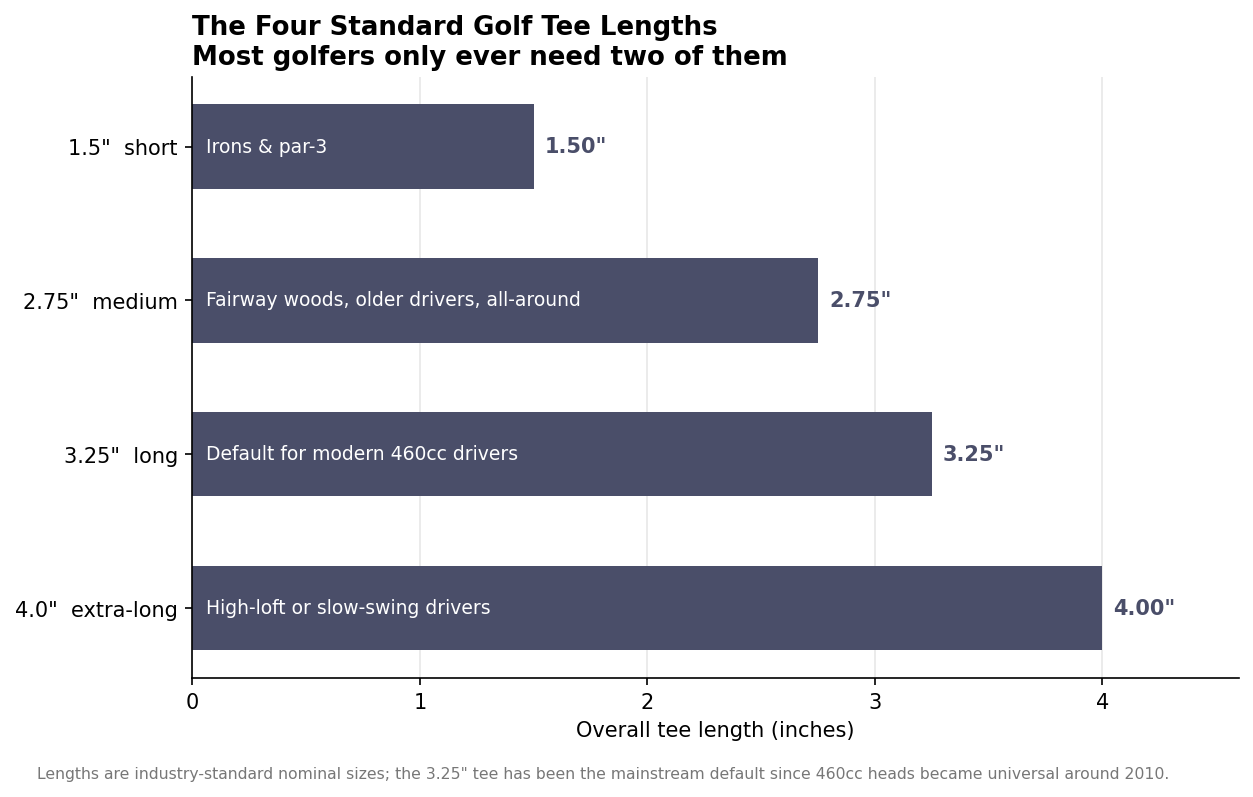
The practical takeaway from that spread is that most golfers genuinely need only two lengths: a long tee for the driver and a short one for irons and the occasional fairway wood. Everything else is refinement. That is also why a bulk order should not be an even split across all four sizes, a point the stocking section returns to.
Why the driver decides the length
Driver head volume is capped at 460cc, and heads have sat at or near that maximum since around 2010. A bigger head has a taller face, and the ball has to be teed higher to strike it on the upswing near the center of the face. The widely used rule is to set the ball so its equator lines up with the top edge of the driver face, which puts roughly half the ball above the crown at address. A quick field check is to push the tee into the ground until only about a thumb’s width of it remains showing; that lands most players close to the right height with a 3.25-inch tee. This is exactly why 3.25 inches overtook the older 2.75 as the standard: the shorter tee simply cannot lift a ball high enough over a 460cc crown without being barely in the ground and unstable. Players with high-loft drivers, very slow swings, or a lot of height often move up to the 4-inch tee for the same reason, more exposed ball.
Everything that is not the driver
Away from the driver the priority flips from height to stability, and the tees get shorter. Off the tee with a fairway wood or hybrid, the ball wants to look perched just barely above the grass rather than floating, so a 2.75-inch tee set low, or even a shorter one, does the job. For irons and par-3s, a 1.5-inch tee pressed almost flush gives a clean strike with the ball only a dimple or two off the turf, which mimics a good lie rather than launching the ball. The 2.75-inch tee is the single most versatile length precisely because it can cover fairway woods, hybrids, and, pushed most of the way in, iron shots too, which makes it the natural second size to carry alongside a long driver tee.
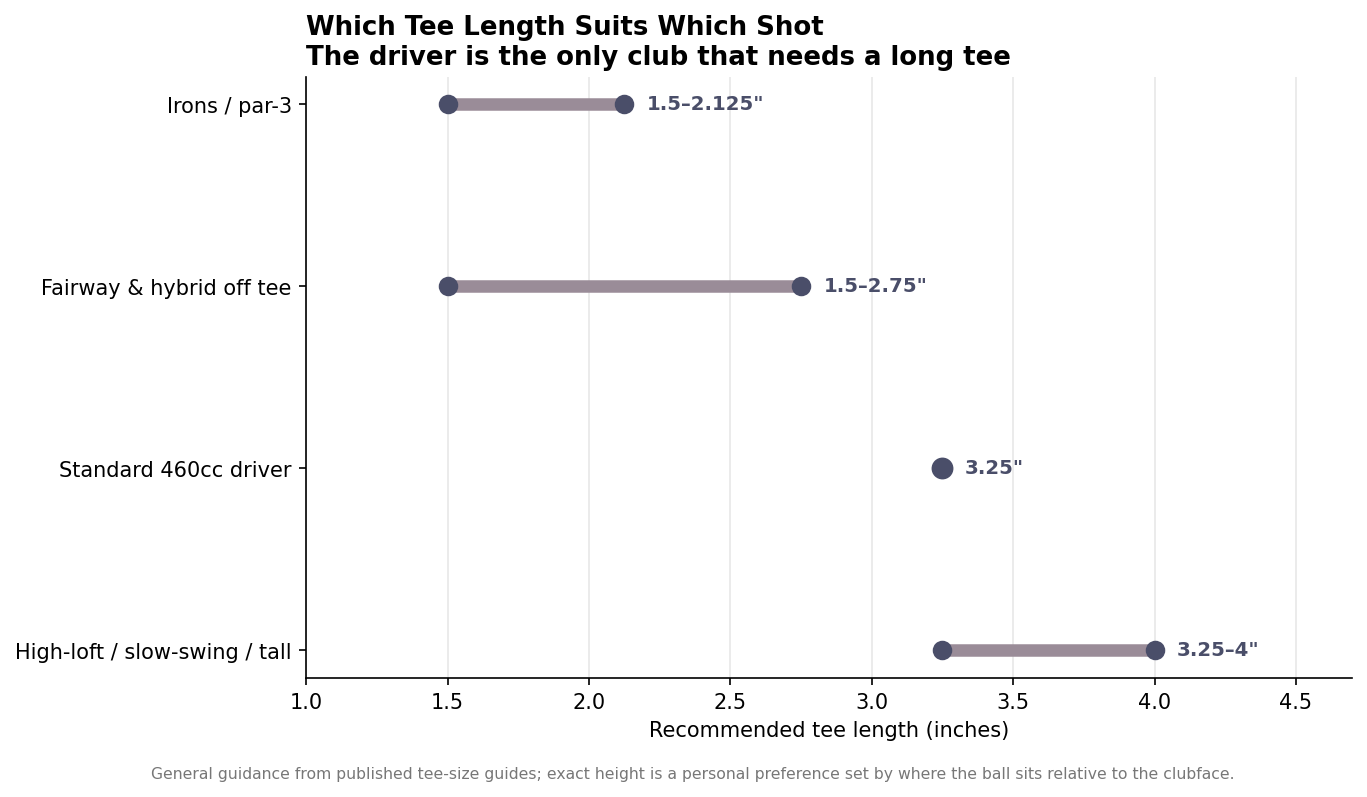
None of these are rigid rules. The right height is ultimately personal and set by where the ball sits relative to the face, so the ranges above are starting points a player fine-tunes. But the shape of the guidance holds: only the driver reaches for a long tee, and shorter clubs want the ball low and stable.
Consistency matters more than the tee itself
Whatever length a player settles on, the value comes from teeing at the same height every time, because a repeatable ball position is what lets the swing groove. This is where length quietly helps: a tee that is the right length for the club can be pushed to a natural, repeatable depth, while a too-short driver tee has to be left barely gripping the ground to get any height, which makes it wobble and vary shot to shot. Length also interacts with breakage. A long tee under a hard driver swing takes real force at impact, and thin or brittle tees snap, which is both an annoyance and a hidden cost across a large order. Stepping up to a sturdier tee in the correct length, rather than forcing a short or flimsy one to do a job it is not built for, tends to pay off in both consistency and how many tees survive a round. For a group order, that reliability is worth more than trimming the per-tee cost.
What to stock for a bulk or event order
For a tournament, a corporate outing, or a pro-shop program, the temptation is to order one length for simplicity, and the mistake is picking the wrong one. The 3.25-inch tee is the workhorse and should make up the bulk of any general order, because it is the one length every driver-swinging player can use and it still functions, pushed deeper, for other clubs in a pinch. If the order only ever includes one size, it should be this one. When budget and logistics allow a second size, add 2.75-inch tees for the iron and fairway-wood crowd and for players who tee low, and keep any 4-inch and short 1.5-inch tees as small specialty quantities rather than core stock. There is also a decoration reason to standardize: the tee shaft is only about 4.7 millimeters across, so the printable band for a logo is narrow and consistent branding is easier when the run is concentrated in one or two lengths rather than scattered across four. Decide the length mix before the artwork, weight it toward the 3.25-inch standard, and the order will fit the field it is meant for.