When you order golf tees in bulk for a tournament, an event, or a branded giveaway, the material you print on quietly sets three things at once: what each tee costs, how long it survives before it snaps, and the environmental story you can tell about it. Wood, bamboo, and plastic each land in a different spot on those trade-offs, and the right pick depends far more on how the tees will be used than on which is “best.” Here is how the three compare and how to choose for a real order.
Wood tees: cheapest, greenest by default, and the first to break
Wooden tees are the standard for a reason — they are the lowest cost per unit and fully biodegradable. Made from hardwoods like birch, they break down naturally if left on the course and are produced without any plastic resin, which makes them an easy environmental story for a giveaway. For high-volume handouts where the tee is essentially disposable and the priority is a low price on thousands of units, wood is hard to beat.
The catch is durability. Wood splinters and snaps more readily than the alternatives, and a wooden tee will often crack after just a shot or a few, especially on iron tee shots or hard ground. That is fine when the tee is a single-use keepsake or a range handout, but it is the wrong choice if you expect recipients to reuse it round after round. Wood does take ink and paint well, so branding is not a problem.
Bamboo tees: the strength upgrade that’s still biodegradable
Bamboo is technically a fast-growing grass, and its long fibers give it high tensile strength along the grain, so a bamboo tee resists breaking noticeably better than a comparable wooden one while remaining biodegradable. It is grown quickly and without the resins that go into plastic, which lets it keep the clean environmental positioning of wood while lasting longer in the bag. That combination is why bamboo has become the default “eco but durable” option.
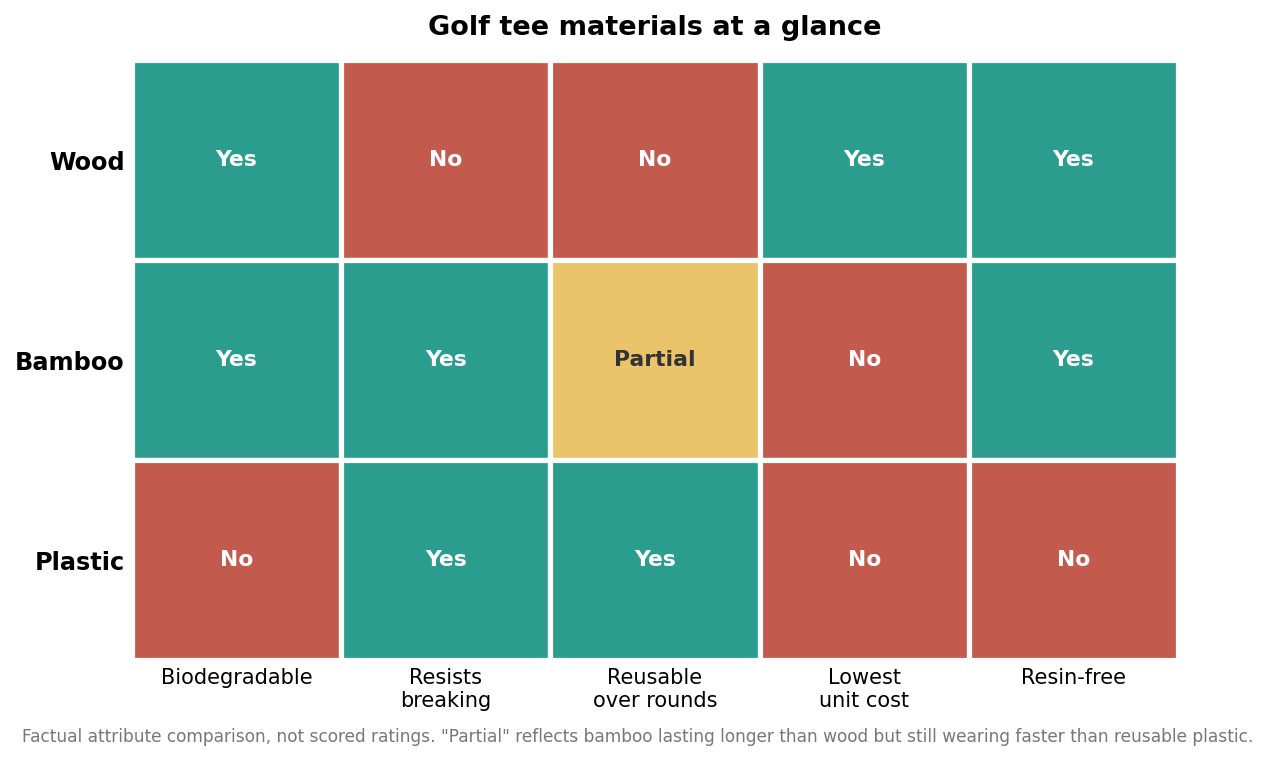
It sits in the middle on price. Bamboo tees generally cost more per unit than plain wood and less than molded plastic, and they print just as cleanly. For a brand that wants a sustainability message but does not want recipients complaining that the tees shatter, bamboo is usually the sweet spot. The summary below lays the three materials side by side.
Plastic tees: durable and reusable, with a footprint
Molded plastic tees are the most durable and the most reusable, surviving many rounds and often built into performance shapes — pronged tops, brush tips, or low-friction designs meant to reduce contact with the ball. If longevity and a premium, engineered feel are the point, plastic delivers, and a single plastic tee can outlast a whole handful of wooden ones.
The trade-off is environmental. Plastic tees are made with resin and do not biodegrade, so they linger on the course, and broken ones get chewed up by mowing equipment, which is why some courses actively discourage them. They also carry the highest unit cost of the three. For a durable, reusable branded tee where the recipient keeps and uses it, plastic makes sense — as long as you are comfortable with the footprint that comes with it.
Be skeptical of distance claims. Many performance plastic tees are marketed on reduced friction and added yards from low-resistance tips or prongs. Any real-world gain is marginal and debated, so treat those claims as a feel-and-durability feature rather than a guaranteed distance boost, and never let a performance shape push a competition order past what the rules allow.
Cost versus durability, and which to order
Line the three up and a clean pattern appears: cost climbs roughly in step with durability. Wood is cheap and short-lived, plastic is pricier and long-lived, and bamboo sits between them while keeping wood’s biodegradable advantage.
Match the material to the job. For a large one-day giveaway or tournament handout where cost per unit rules and the tees are effectively disposable, wood or bamboo is the call — bamboo if you want the eco message without the breakage complaints. For a premium gift or a performance-minded audience who will reuse the tee, plastic earns its higher price. And if sustainability is central to your brand, bamboo lets you say something genuine about the product without sacrificing much durability.
Factor breakage into the quantity you order. Because wood snaps most readily, an order of wooden tees should build in a comfortable buffer rather than one tee per expected golfer — extra units cost little at bulk pricing and spare you from running short at an event. Bamboo needs a smaller cushion, and durable plastic the least, so the cheapest material per unit is not always the cheapest way to make sure every player leaves with a usable tee.
Printing, sizing, and staying within the rules
All three materials brand well at the common tee sizes, typically the 2¾-inch and 3¼-inch lengths, with the print area being the narrow shaft below the cup — a small canvas that rewards a simple, high-contrast logo over fine detail. Whatever material you choose, keep the artwork bold and legible at that scale rather than cramming in text that will disappear at arm’s length.
If the tees are for competitive play, stay inside the Rules of Golf. Under Rule 6.2b, a tee may not be longer than 4 inches (101.6mm), and it must not be designed to indicate the line of play or to influence the movement of the ball. Standard wood, bamboo, and plastic tees in normal shapes are conforming, but some novelty or performance plastic designs are not, so if your order is destined for a sanctioned tournament, confirm the tee is on conforming footing before you print several thousand of them.