“Eco-friendly” has become a standard line item on the brief for tournament tees and branded golf giveaways, and for good reason: a single charity scramble can put thousands of tees into the turf in an afternoon, and most of them snap on the first drive. But the word covers a lot of ground, and the difference between a tee that starts breaking down in a season and one that outlives the golfer who used it comes down entirely to the material. If you are ordering custom tees in bulk and want the environmental claim on the packaging to hold up, it is worth understanding what actually happens to each material after it leaves the tee box.
What happens to a tee after it snaps
The honest starting point is that almost every tee is a single-use item in practice. Players rarely retrieve a broken tee, so the relevant question is not durability in the hand but what the tee does once it is left in the ground. Here the three common materials diverge sharply. Bamboo tees begin to biodegrade in roughly six months under normal soil conditions. Traditional wooden tees, usually birch or white pine, are also biodegradable but far slower, taking on the order of three years to break down fully. Plastic tees do neither on any meaningful timescale; they fragment and persist, and the pieces can work their way into mowers and drainage rather than returning to the soil.
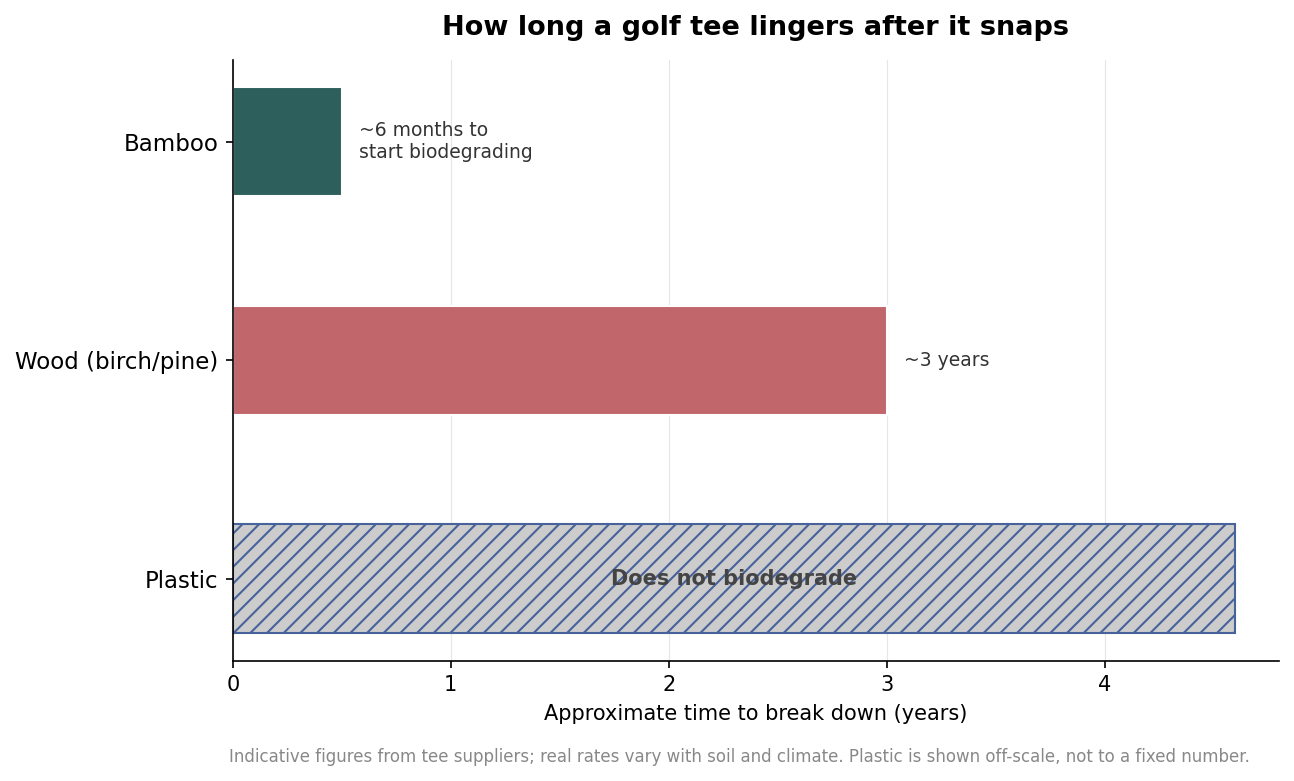
Those figures are indicative rather than laboratory-exact, and real decomposition depends on climate, soil, and how deep the fragment is buried. The relative order, though, is consistent across sources: bamboo returns to the environment fastest, wood eventually gets there, and plastic essentially does not. That is why a growing number of clubs and some major tournaments now discourage plastic tees outright and steer events toward wood or bamboo.
Why bamboo behaves differently from wood
It helps to know that bamboo is not a wood at all. It is a fast-growing grass, and that biology drives both of its selling points. Because it grows so quickly and regenerates from the same root system without replanting, it is one of the more rapidly renewable raw materials available, which is the basis for the “sustainable” claim most bamboo tee sellers make. The same dense fiber structure that lets a grass stalk stand tall also makes the finished tee resist snapping. Suppliers commonly report bamboo tees as roughly one and a half times more break-resistant than an average wooden tee, so a golfer gets more shots per tee before it fails.
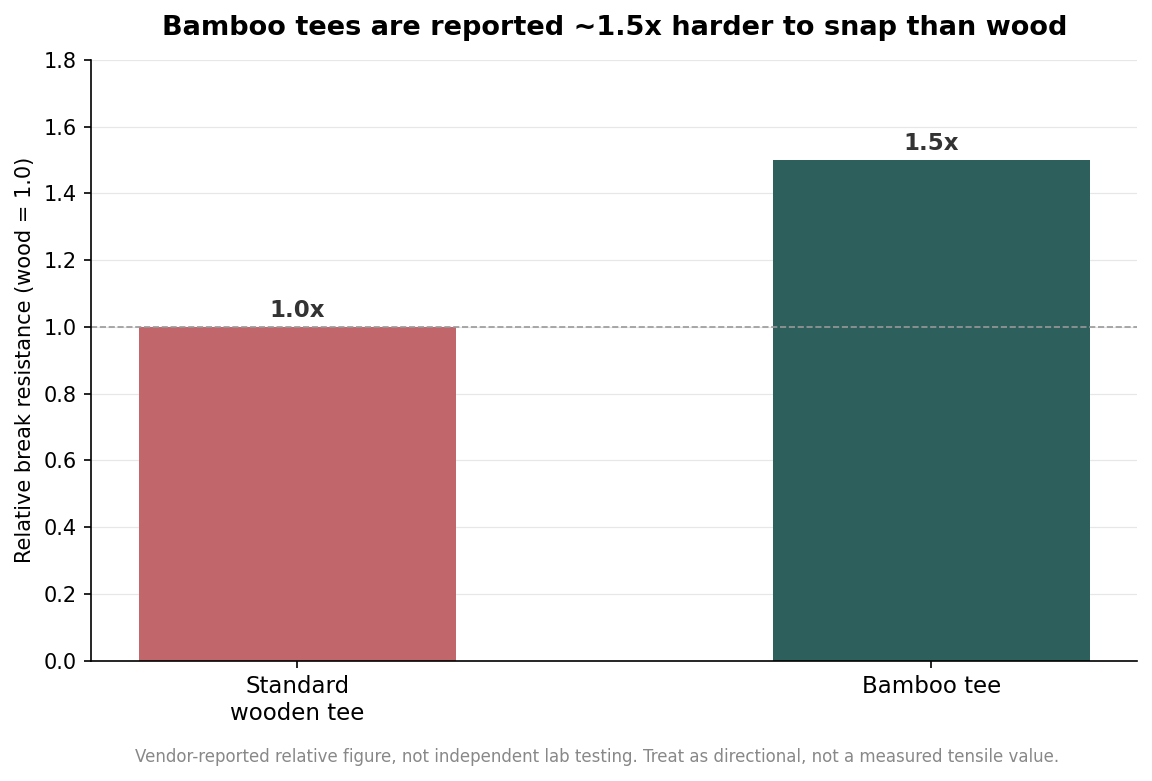
That strength figure deserves a caveat. It comes from tee manufacturers rather than independent testing, and the broader claim that bamboo fiber is “three times as strong as wood” describes the raw material in general, not a controlled test of tees specifically. Treat it as directional: bamboo tees do tend to break less, but the exact multiple is a marketing figure, not a measured tensile value. What is not in dispute is that bamboo splits cleanly rather than shattering, which is part of why players describe it as feeling firmer at address.
Where wood still makes sense
None of this makes wood a poor choice, and for many bulk buyers it remains the right one. Wooden tees are the least expensive to produce at volume, they take an ink-printed logo cleanly, and they are unambiguously biodegradable, which satisfies most “eco” requirements for a tournament without paying the bamboo premium. If the priority is the lowest cost per tee for a large one-day giveaway and the tees will be used on a well-maintained course that collects debris, painted birch tees do the job. Bamboo earns its slightly higher price when the brand story is explicitly about sustainability, when you want fewer broken tees per player, or when the event markets itself as green and the tee is part of that message.
Specifying an eco tee order that holds up
If you want the environmental claim to survive scrutiny, keep the language precise on the packaging. “Biodegradable” is accurate for both wood and bamboo; “compostable” is a stronger, standards-based term that you should not use unless your supplier can back it. Avoid calling plastic tees eco-friendly under any framing. When you request a quote, confirm the wood species or that the bamboo is genuine bamboo rather than a bamboo-plastic composite, since some “bamboo” tees are blended with resin and lose the biodegradability that is the whole point. Match the tee length to the event as usual, and remember that a natural, undyed or lightly stained finish reads as more sustainable to attendees than a bright painted tee, even though both biodegrade similarly.
It is also worth thinking about cost in the right unit. Buyers instinctively compare the price per tee, but for an event the more useful figure is cost per round of play. A wooden tee that snaps on the first or second swing can quietly cost more in replacements and litter than a bamboo tee that survives several drives, even though the bamboo unit price is higher on the invoice. If your tees double as a keepsake that players pocket rather than discard, that longevity also stretches the impressions your logo earns from a single order, which is the quiet argument for spending a little more on the material.
The short version: if the goal is genuinely lower environmental impact, bamboo is the strongest story and the most break-resistant tee, wood is the budget-friendly biodegradable default, and plastic belongs on a driving range mat rather than in a giveaway that carries your logo. Order the material that matches the claim you plan to print, keep the packaging language precise, and the rest of the specification is the same tee-length and logo work as any other custom run.