Category: Uncategorized

  • Standard, Castle, Brush, or Short: Which Golf Tee Design to Brand

    Standard, Castle, Brush, or Short: Which Golf Tee Design to Brand

    Most people ordering custom golf tees for an outing pick a length, choose wood or bamboo, and stop there. But there is a second decision that changes how the tee plays and how your logo reads on it: the shape of the tee itself. Standard spikes, castle (step) tees, brush tees, and stubby par-3 tees are all different tools, and for a branded bulk order the design you choose affects consistency for your players, how many you go through, and how much clean surface you have to print on. Here is how the common designs differ and how to spec them for an event.

    The standard tee still fits almost everyone

    The classic tapered spike is the default for good reasons. It suits every club, it is the cheapest to produce in volume, and its long smooth shank is the easiest surface to imprint a logo or event name on. For a tournament giveaway where players bring mixed skill levels and swing every club in the bag, a standard tee in a versatile length is the safe call. Modern 460cc drivers generally want a longer tee, around 3.25 inches, so the ball’s equator sits at the top edge of the face; fairway woods and older compact drivers sit lower at about 2.75 inches; and irons on par-3s use a short 1.5-inch tee pushed nearly flush. If you are buying one length for a whole field, 3.25 inches covers the driver-heavy majority while still working shorter. The chart below maps length to club.
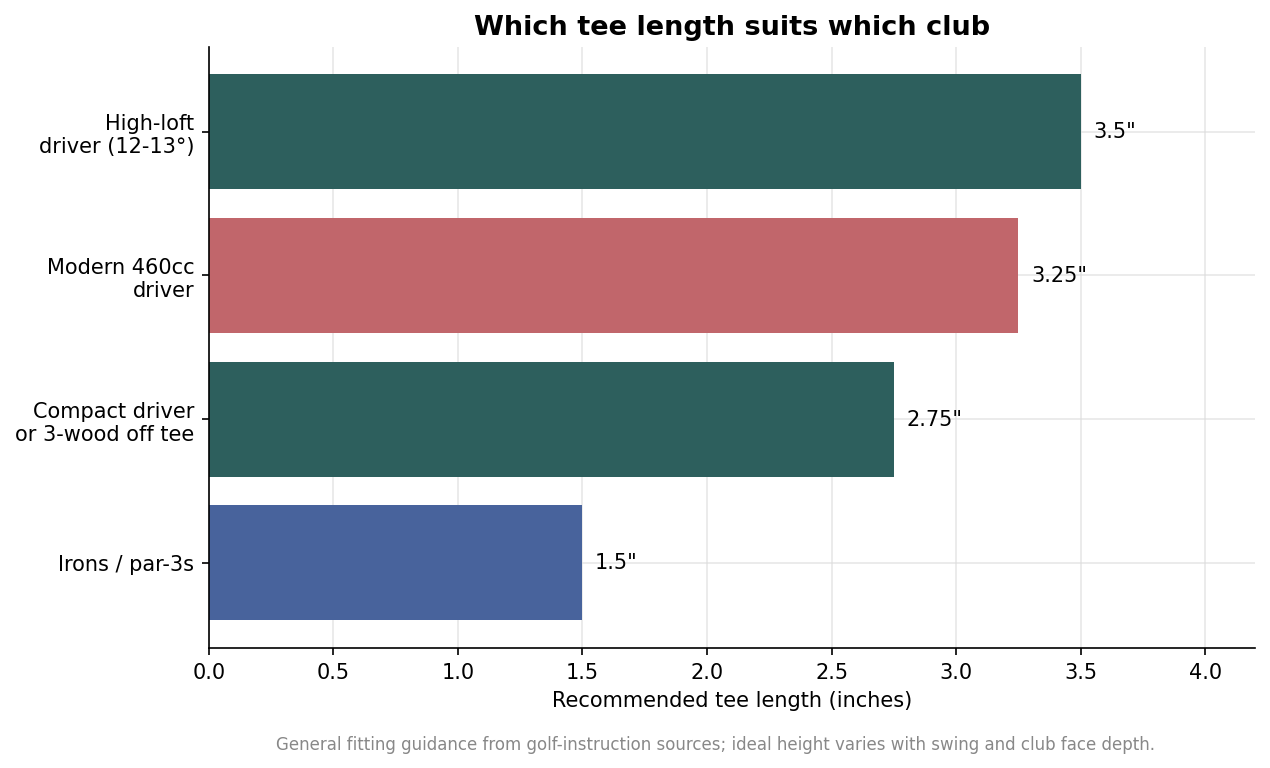
    Horizontal bar chart of recommended golf tee length by club: irons 1.5 inch, compact driver or 3-wood 2.75 inch, 460cc driver 3.25 inch, high-loft driver 3.5 inch
    A single 3.25-inch tee covers most of a driver-heavy field; shorter clubs want less height.

    Castle and step tees fix inconsistent height

    A castle tee — sometimes called a step tee — solves a real problem: teeing the ball at the same height every time. Instead of guessing how deep to push a spike into turf that ranges from soft to rock-hard, the golfer pushes the tee down until the raised collar or “steps” stop it at a fixed height. That repeatability is the selling point; independent coverage of these designs frames the benefit as tighter launch consistency rather than raw distance. For a corporate scramble full of occasional golfers, a castle tee can genuinely make the first shot less of a lottery. The trade-offs are cost and print area: they run a little more per unit than a plain spike, and the stepped or collared section eats into the smooth shank, so your imprint window is smaller. If you go this route, confirm the printable zone before approving artwork.

    Brush and low-friction tees chase a marginal gain

    Brush tees replace the solid cup with bristles, and “zero-friction” designs use a pronged or pared-down top, both aiming to reduce contact between tee and ball at impact. The theory is less resistance, so slightly more energy transfers to the ball. Be honest with your expectations here: testing generally puts the distance benefit at under two yards, which no weekend player will notice. Where these designs earn their place is novelty and talking-point value — they look different in a goodie bag and signal that some thought went into the gift. For branding, the bristle versions offer very little printable hard surface, so the logo usually lives on the plastic base rather than the shank. Order these as a premium or novelty tier, not as your bulk workhorse.

    Short and par-3 tees for a specific hole

    The 1.5-inch tee is a niche but useful item, especially for par-3 course events or a specific hole sponsorship. It positions an iron shot just off the turf without the ball ballooning, and because it is small and cheap it is easy to hand out in quantity. It is a poor choice as a general giveaway because it will not tee a driver, so treat it as a supplement to a standard tee rather than a replacement. If your event has a par-3 contest or a hole-in-one hole, a small run of branded short tees dedicated to that station is a nice touch that most organizers overlook.

    Keep it conforming, and spec the print early

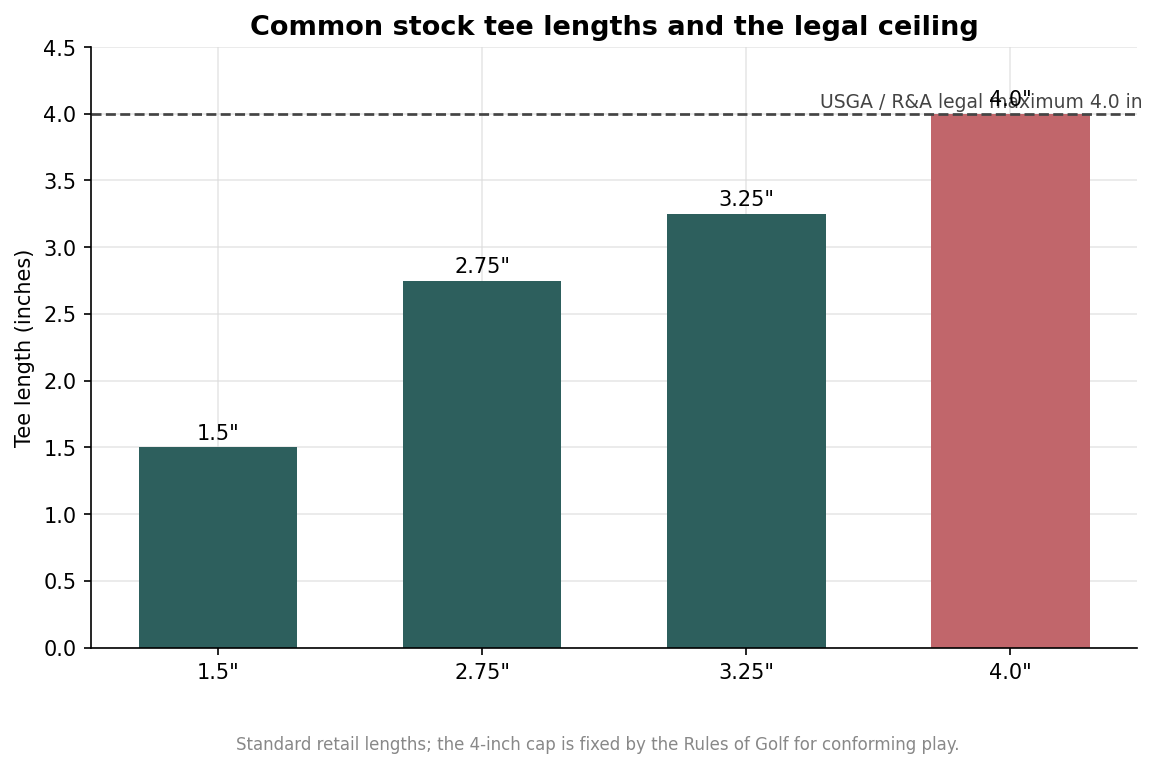
    Whatever design you choose, the length is capped: the USGA and R&A set a maximum legal tee length of 4 inches for conforming play. Any stock length at or under that is fine for a real tournament, and the common retail sizes — 1.5, 2.75, 3.25, and 4.0 inches — all sit within the rule, as the chart below shows.
    Bar chart of common stock golf tee lengths 1.5, 2.75, 3.25 and 4.0 inches with a dashed line marking the USGA and R&A 4-inch legal maximum
    Every common stock length sits at or below the 4-inch legal ceiling.

    The practical steps for a clean bulk order are the same across designs: pick the length that matches the majority of your field, choose the design tier deliberately (standard for the field, a premium design only where it adds something), and lock the imprint area against the specific tee before art goes to production, because a step, collar, or brush cup shrinks the usable surface. Nail those and a six-millimeter-wide giveaway ends up doing real work — in a player’s hand on every hole, and in their bag long after the event.
  • Are Your Tournament Golf Tees Conforming? The Rules on Tees, Explained

    Are Your Tournament Golf Tees Conforming? The Rules on Tees, Explained

    Almost nobody orders custom golf tees worrying about the rulebook, and for most events that instinct is correct. But if you are buying tees for a club championship, an association event, or anything where scores will count, it is worth knowing that the Rules of Golf actually regulate the tee itself — not just how you use it. The good news is that a standard printed tee is conforming by default, and it takes a genuinely unusual design to run afoul of the rules. Here is what the Rules say, when it matters, and how to make sure a bulk order is safe either way.

    When the Rules actually apply to your tees

    The Rules of Golf govern play in formal competition and in any round a player intends to post for handicap purposes. A charity scramble, a corporate outing, or a company fun day is usually not played under strict Rules, and in that setting nobody is going to disqualify a foursome over their tees. The moment scores matter — a member-guest with a real trophy, a club championship, a state or regional association event — the equipment has to conform, and that includes the humble tee. So the practical test is simple: if the event feeds a handicap or crowns a champion, buy conforming tees; if it is a social outing, you have more latitude, though there is rarely a reason not to stay conforming anyway.

    The one number that matters: four inches

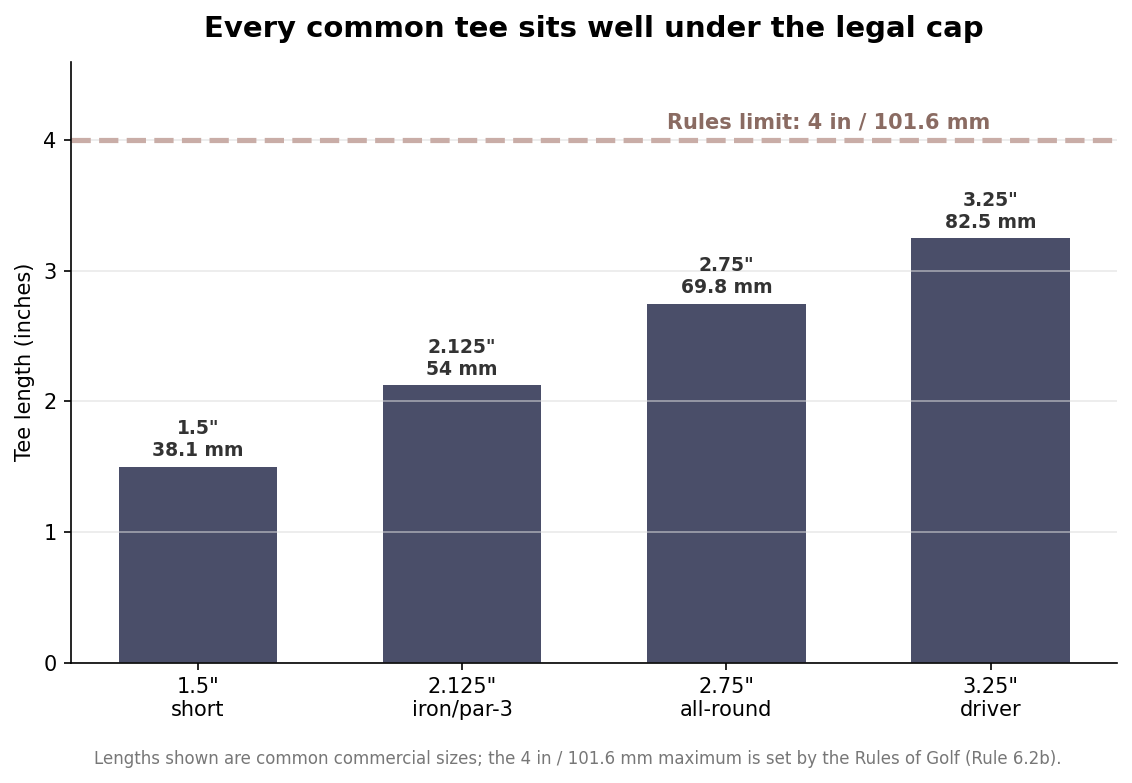
    The headline requirement is length. Under the Equipment Rules that sit behind Rule 6.2b, a tee must not be longer than 4 inches, which is 101.6 millimeters. That is the entire length limit, and it is generous. The tees you actually buy in bulk cluster well below it: a 2.75-inch tee is the common all-round size, a 3.25-inch tee is the popular choice for teeing a modern driver, and shorter 2.125-inch tees suit irons and par-3 shots. Even the tallest standard driver tee leaves the better part of an inch of headroom under the cap.

    Bar chart of common golf tee lengths (1.5, 2.125, 2.75, 3.25 inches) all below the 4 inch / 101.6 mm Rules of Golf limit shown as a dashed line
    Common tee sizes sit well under the 4-inch (101.6 mm) legal maximum.

    The only length trap is the occasional novelty “power” or extra-long tee sold on the promise of more height. Anything marketed as taller than four inches is non-conforming on its face, and it is the one length-related mistake a buyer can make without realizing it. Stick to standard sizes and length is a non-issue.

    The prohibitions that catch novelty tees

    Length is the easy part. The Rules add three design prohibitions that matter far more for anyone tempted by a gimmick. A tee must not be designed or manufactured in a way that could indicate the line of play, must not unduly influence the movement of the ball, and must not otherwise assist the player in making a stroke or in their play. In plain terms, a tee cannot double as an aiming aid or a swing aid.

    This is what makes certain novelty tees non-conforming. A tee molded with an arrow or a pointer that a player lines up toward the target is indicating the line of play. A tee with an exaggerated cup or fins engineered to launch the ball is straying into unduly influencing its movement. Reduced-friction and brush-style tees are generally accepted because they do not meaningfully change ball flight, but the closer a design gets to promising free distance or built-in alignment, the closer it gets to the line. For a bulk buyer the lesson is that a conventional tee — wood, bamboo, or plastic, with a normal cup and a printed logo — satisfies all three prohibitions without you having to think about it. The risk lives entirely in the specialty shapes.

    Reading a spec sheet in both units

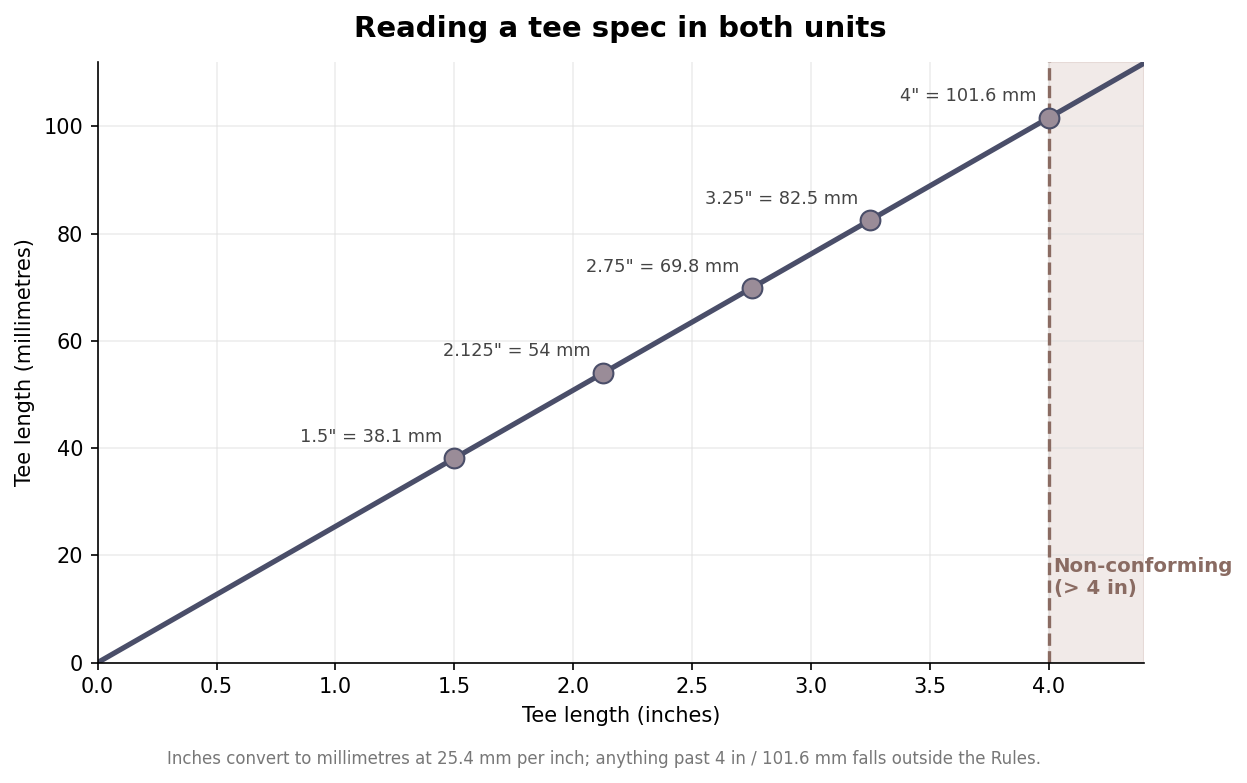
    One reason length confusion creeps in is that tees are quoted in inches by American suppliers and in millimeters by many overseas factories, and a spec sheet may mix both. The conversion is fixed at 25.4 millimeters per inch, so the four-inch cap is exactly 101.6 millimeters, a 3.25-inch driver tee is about 82.5 millimeters, and a 2.75-inch tee is roughly 69.8 millimeters. If a quote lists a length in millimeters, converting it back and checking it against 101.6 is a five-second way to confirm conformance before you approve a sample.

    Line chart converting tee length from inches to millimeters at 25.4 mm per inch, with the region beyond 4 inches shaded as non-conforming
    Inches convert at 25.4 mm each; anything over 4 in / 101.6 mm is non-conforming.

    Keeping both units in view also helps when you are matching a custom order to tees a golfer already likes, since the length they name will often be in whichever unit their current brand prints on the pack. As long as the number lands below 101.6 millimeters, the tee clears the length rule, and every standard size does so comfortably.

    Ordering tees that are safe either way

    The simplest way to stay out of trouble is to default to conventional tees for anything that might be played competitively, and to reserve novelty shapes for social giveaways where the Rules are not in force. A plain wood or bamboo tee in a 2.75-inch or 3.25-inch length, printed with your logo, is conforming, familiar to every golfer, and cheap to produce at volume — which is exactly why it is the workhorse of the custom-tee business. If a client specifically wants an unusual design, it is worth asking what event it is for before you order, because a tee that is perfect for a branded booth handout could quietly disqualify a player who tees it up in a counting round. Length under four inches, a normal cup, and no built-in aiming or launching features is the whole checklist, and standard tees pass it every time. Get those basics right and the rulebook becomes one less thing to think about when you place the order.

  • Biodegradable Golf Tees: What “Eco-Friendly” Actually Means for a Bulk Order

    Biodegradable Golf Tees: What “Eco-Friendly” Actually Means for a Bulk Order

    “Eco-friendly” has become a standard line item on the brief for tournament tees and branded golf giveaways, and for good reason: a single charity scramble can put thousands of tees into the turf in an afternoon, and most of them snap on the first drive. But the word covers a lot of ground, and the difference between a tee that starts breaking down in a season and one that outlives the golfer who used it comes down entirely to the material. If you are ordering custom tees in bulk and want the environmental claim on the packaging to hold up, it is worth understanding what actually happens to each material after it leaves the tee box.

    What happens to a tee after it snaps

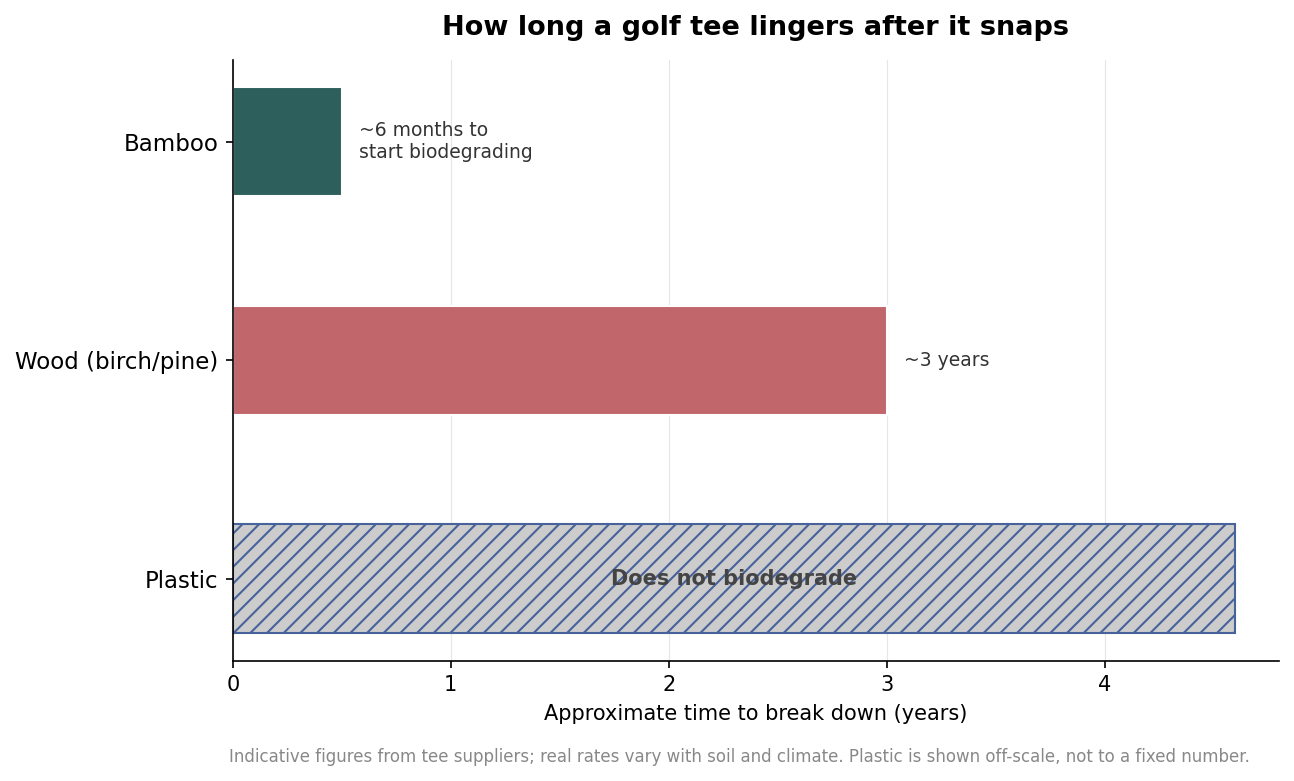
    The honest starting point is that almost every tee is a single-use item in practice. Players rarely retrieve a broken tee, so the relevant question is not durability in the hand but what the tee does once it is left in the ground. Here the three common materials diverge sharply. Bamboo tees begin to biodegrade in roughly six months under normal soil conditions. Traditional wooden tees, usually birch or white pine, are also biodegradable but far slower, taking on the order of three years to break down fully. Plastic tees do neither on any meaningful timescale; they fragment and persist, and the pieces can work their way into mowers and drainage rather than returning to the soil.

    Horizontal bar chart comparing approximate time to biodegrade for bamboo, wood, and plastic golf tees
    Bamboo begins breaking down in about six months; wood takes roughly three years; plastic does not biodegrade.

    Those figures are indicative rather than laboratory-exact, and real decomposition depends on climate, soil, and how deep the fragment is buried. The relative order, though, is consistent across sources: bamboo returns to the environment fastest, wood eventually gets there, and plastic essentially does not. That is why a growing number of clubs and some major tournaments now discourage plastic tees outright and steer events toward wood or bamboo.

    Why bamboo behaves differently from wood

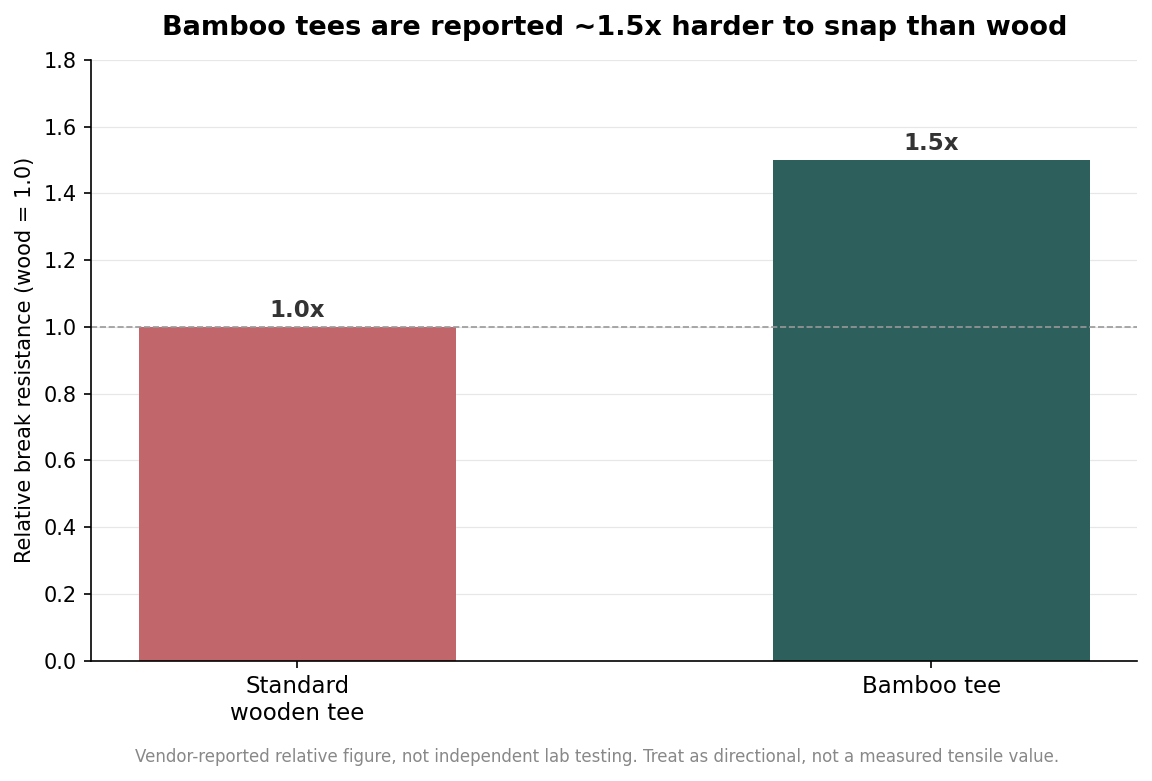
    It helps to know that bamboo is not a wood at all. It is a fast-growing grass, and that biology drives both of its selling points. Because it grows so quickly and regenerates from the same root system without replanting, it is one of the more rapidly renewable raw materials available, which is the basis for the “sustainable” claim most bamboo tee sellers make. The same dense fiber structure that lets a grass stalk stand tall also makes the finished tee resist snapping. Suppliers commonly report bamboo tees as roughly one and a half times more break-resistant than an average wooden tee, so a golfer gets more shots per tee before it fails.

    Bar chart showing bamboo golf tees as about 1.5 times more break-resistant than standard wooden tees
    Suppliers report bamboo tees as roughly 1.5x harder to snap than wood, though this is a vendor figure, not lab-tested.

    That strength figure deserves a caveat. It comes from tee manufacturers rather than independent testing, and the broader claim that bamboo fiber is “three times as strong as wood” describes the raw material in general, not a controlled test of tees specifically. Treat it as directional: bamboo tees do tend to break less, but the exact multiple is a marketing figure, not a measured tensile value. What is not in dispute is that bamboo splits cleanly rather than shattering, which is part of why players describe it as feeling firmer at address.

    Where wood still makes sense

    None of this makes wood a poor choice, and for many bulk buyers it remains the right one. Wooden tees are the least expensive to produce at volume, they take an ink-printed logo cleanly, and they are unambiguously biodegradable, which satisfies most “eco” requirements for a tournament without paying the bamboo premium. If the priority is the lowest cost per tee for a large one-day giveaway and the tees will be used on a well-maintained course that collects debris, painted birch tees do the job. Bamboo earns its slightly higher price when the brand story is explicitly about sustainability, when you want fewer broken tees per player, or when the event markets itself as green and the tee is part of that message.

    Specifying an eco tee order that holds up

    If you want the environmental claim to survive scrutiny, keep the language precise on the packaging. “Biodegradable” is accurate for both wood and bamboo; “compostable” is a stronger, standards-based term that you should not use unless your supplier can back it. Avoid calling plastic tees eco-friendly under any framing. When you request a quote, confirm the wood species or that the bamboo is genuine bamboo rather than a bamboo-plastic composite, since some “bamboo” tees are blended with resin and lose the biodegradability that is the whole point. Match the tee length to the event as usual, and remember that a natural, undyed or lightly stained finish reads as more sustainable to attendees than a bright painted tee, even though both biodegrade similarly.

    It is also worth thinking about cost in the right unit. Buyers instinctively compare the price per tee, but for an event the more useful figure is cost per round of play. A wooden tee that snaps on the first or second swing can quietly cost more in replacements and litter than a bamboo tee that survives several drives, even though the bamboo unit price is higher on the invoice. If your tees double as a keepsake that players pocket rather than discard, that longevity also stretches the impressions your logo earns from a single order, which is the quiet argument for spending a little more on the material.

    The short version: if the goal is genuinely lower environmental impact, bamboo is the strongest story and the most break-resistant tee, wood is the budget-friendly biodegradable default, and plastic belongs on a driving range mat rather than in a giveaway that carries your logo. Order the material that matches the claim you plan to print, keep the packaging language precise, and the rest of the specification is the same tee-length and logo work as any other custom run.

  • Custom Golf Tees for a Tournament: How Many to Order and How to Pack Them

    Custom Golf Tees for a Tournament: How Many to Order and How to Pack Them

    Ordering custom golf tees for a tournament is a different job from buying tees for yourself. You are not choosing what feels good off your own driver; you are provisioning a field of players you will never meet, most of whom will pocket the tee, use two of them, and lose the rest in the rough. The goal is a giveaway that looks sharp on the tee box, survives a full round, and arrives before your event. Get the length, material, quantity, and packaging right and the rest takes care of itself.

    Start with the length the field will actually use

    Printed golf tees usually come in three stock lengths: 2 1/8 inch, 2 3/4 inch, and 3 1/4 inch. For a mixed field, the 2 3/4 inch tee is the safe default. It suits the drivers most amateurs carry and still works for fairway woods, which is why the majority of tournament tee packs are built around it. Step up to 3 1/4 inch only if you know your players are swinging large 460cc driver heads and want the extra height, and keep the 2 1/8 inch tee in mind for iron and hybrid shots on par threes. When in doubt, one length across the whole order keeps packing simple and costs down; you are supplying a keepsake and a functional tee, not fitting each golfer individually.

    Match the material to the giveaway, not to your own bag

    Wood is the least expensive option and the one most people picture, but it is also the one that snaps. For a high-volume outing where the tee is a throwaway courtesy, cheap wood is perfectly reasonable. Bamboo costs a little more and is noticeably tougher; players commonly report getting through a round on just two to four bamboo tees rather than a fistful, and it carries a renewable, eco-friendly story that reads well on a charity or corporate event. Plastic tees flex instead of breaking and take bright, saturated colors, which can make a logo pop, though some traditionalists dislike them. Because a durable tee is one a golfer keeps and reuses, spending slightly more per unit on bamboo or plastic can mean your branding rides along for weeks instead of ending up in a trash can at the first tee.

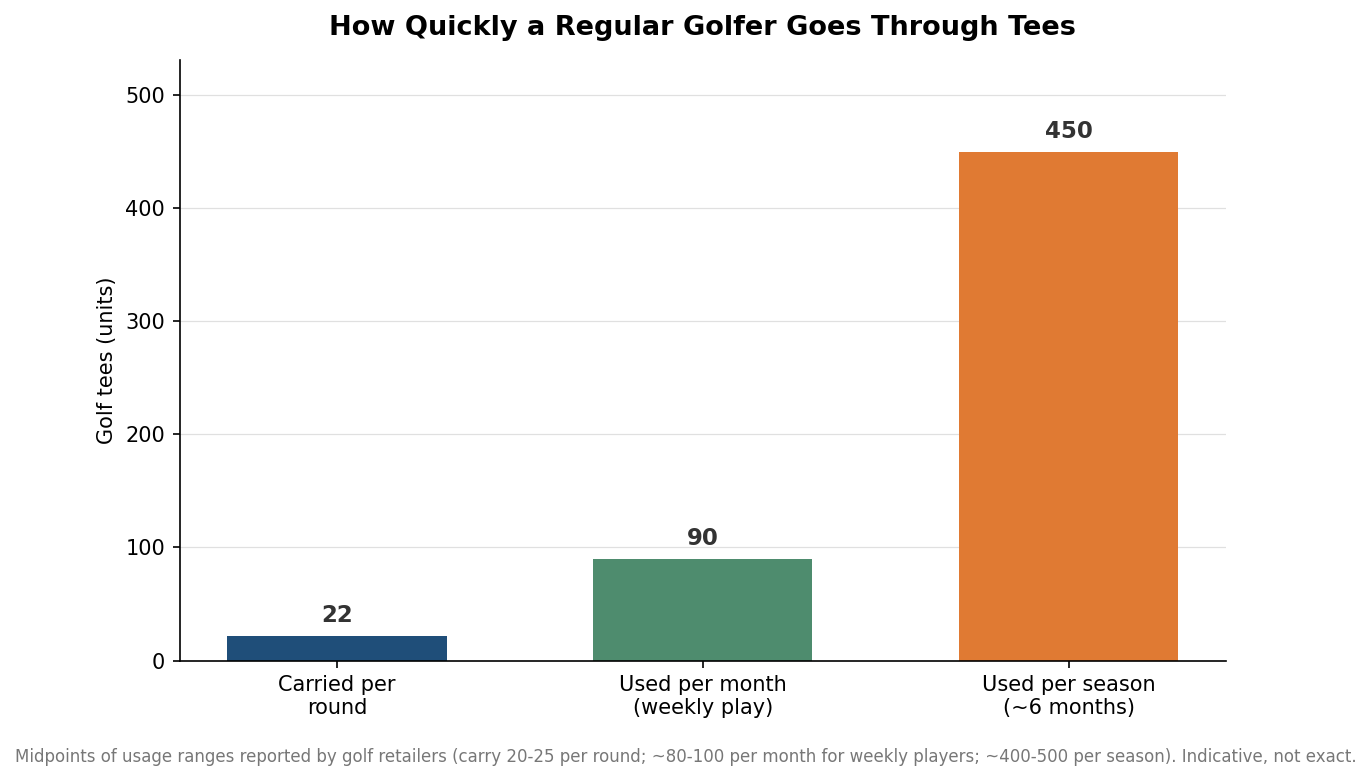
    Bar chart showing golf tees a regular golfer carries per round, uses per month, and uses per season
    How quickly a regular golfer works through tees, from a single round to a full season.

    Work out how many to order

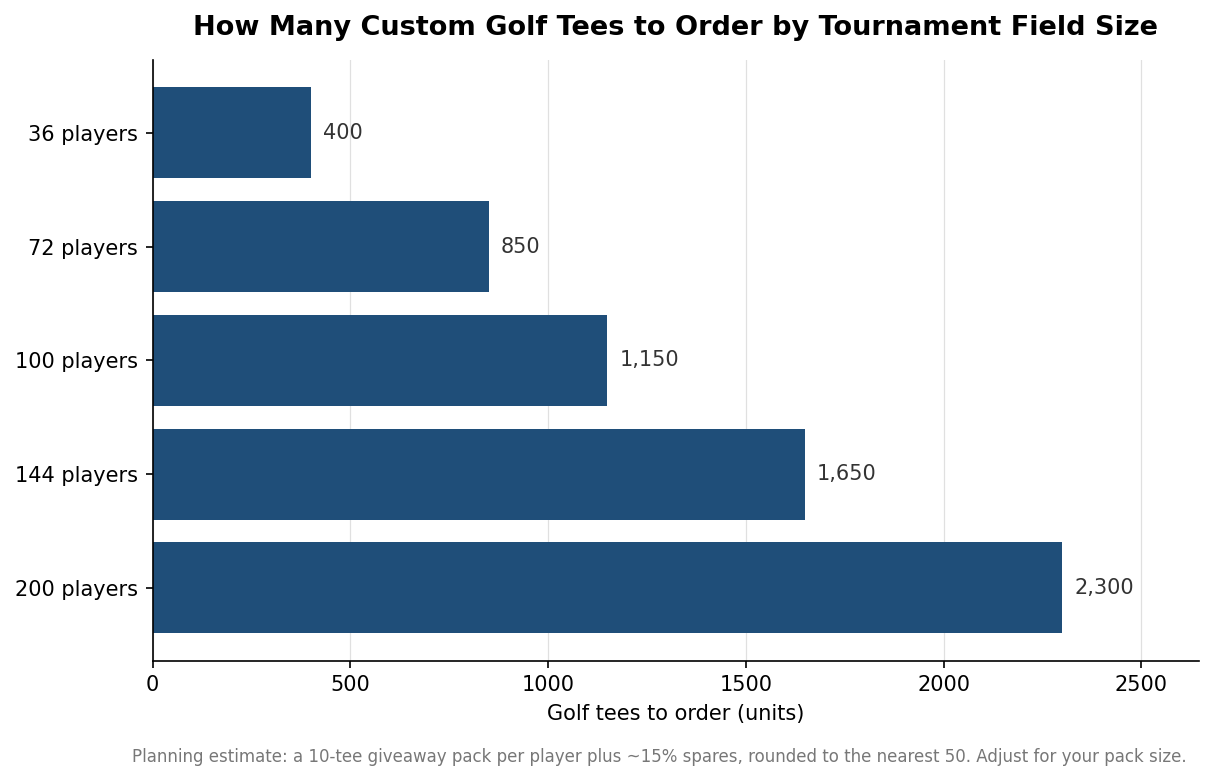
    This is where most first-time organizers guess and either run short or drown in leftovers. A single golfer typically carries 20 to 25 tees for a round, but that is personal supply, not what you hand out. For an event giveaway, the common convention is a pack of around 10 tees per player, sometimes bundled with a ball marker. From there the math is simple: multiply your field by the pack size, then add roughly 15 percent for sponsors, volunteers, no-shows who still get a bag, and the inevitable reorder you forgot about. A 144-player scramble at 10 tees a head plus spares lands near 1,650 tees. The chart below runs that estimate across common field sizes so you can start from a real number rather than a hunch.

    Horizontal bar chart of custom golf tees to order by tournament field size from 36 to 200 players
    A planning estimate of tees to order by field size, at roughly 10 tees per player plus spares.

    Two caveats keep this honest. First, these are planning figures, not a rule; if your pack holds four tees or twenty, rescale accordingly. Second, order quantity matters. Customized Golf Tees starts at just 12 tees, which is fine for a small member-guest, but tournament runs usually sit in the 250 to 1,000-plus range where per-unit pricing improves. Ordering a slightly larger round number is often cheaper per tee than you expect and leaves you stocked for next year.

    Let the packaging do the talking

    The same tee reads completely differently depending on how it is presented. Bulk boxes give you the lowest cost per unit and suit tees dumped into a bowl on the registration table or scattered in a cart. Ten-tee combo packs and pillow packs with a poker-chip ball marker feel like a gift and are the workhorse of player goodie bags. Matchbook-style tee packets are flat, cheap to mail, and print edge to edge, which makes them a favorite for sponsor logos. At the premium end, tee tubes that hold a couple of branded golf balls alongside the tees turn a giveaway into a prize for closest-to-the-pin or a raffle. Decide first whether the tees are a courtesy or a keepsake, because that single choice drives both the packaging and the budget more than the tee itself does.

    Nail the imprint, the proof, and the lead time

    Most tees are decorated with a single-color pad or screen print on the shank, which offers a surprisingly generous imprint area for a logo, a phone number, or a short web address. Multi-color and wrap-around printing exist at some vendors but add cost and time, so keep the artwork clean and high-contrast; a two-tone logo on a dark tee can disappear at arm’s length. Always ask for a virtual proof and approve it before production runs, because a typo multiplied across 1,500 tees is an expensive lesson. On timing, with Customized Golf Tees standard production ships in 2 to 4 weeks after artwork approval; faster turnaround is available with express shipping. The practical advice is to allow 2 to 4 weeks for production plus shipping time, and order earlier if your event date is fixed, so a proof revision or a shipping delay never becomes a crisis on tournament morning.

    Put those decisions together and custom golf tees become one of the easiest wins in event planning: choose 2 3/4 inch as your default length, pick a material that matches whether the tee is a courtesy or a keepsake, order your field size times the pack plus a cushion, and wrap it in packaging that fits the moment. Do that, and every player tees off with your name in their hand.

  • Wood vs Bamboo vs Plastic Golf Tees: How to Choose for a Bulk Order

    Wood vs Bamboo vs Plastic Golf Tees: How to Choose for a Bulk Order

    When you order golf tees in bulk for a tournament, an event, or a branded giveaway, the material you print on quietly sets three things at once: what each tee costs, how long it survives before it snaps, and the environmental story you can tell about it. Wood, bamboo, and plastic each land in a different spot on those trade-offs, and the right pick depends far more on how the tees will be used than on which is “best.” Here is how the three compare and how to choose for a real order.

    Wood tees: cheapest, greenest by default, and the first to break

    Wooden tees are the standard for a reason — they are the lowest cost per unit and fully biodegradable. Made from hardwoods like birch, they break down naturally if left on the course and are produced without any plastic resin, which makes them an easy environmental story for a giveaway. For high-volume handouts where the tee is essentially disposable and the priority is a low price on thousands of units, wood is hard to beat.

    The catch is durability. Wood splinters and snaps more readily than the alternatives, and a wooden tee will often crack after just a shot or a few, especially on iron tee shots or hard ground. That is fine when the tee is a single-use keepsake or a range handout, but it is the wrong choice if you expect recipients to reuse it round after round. Wood does take ink and paint well, so branding is not a problem.

    Bamboo tees: the strength upgrade that’s still biodegradable

    Bamboo is technically a fast-growing grass, and its long fibers give it high tensile strength along the grain, so a bamboo tee resists breaking noticeably better than a comparable wooden one while remaining biodegradable. It is grown quickly and without the resins that go into plastic, which lets it keep the clean environmental positioning of wood while lasting longer in the bag. That combination is why bamboo has become the default “eco but durable” option.

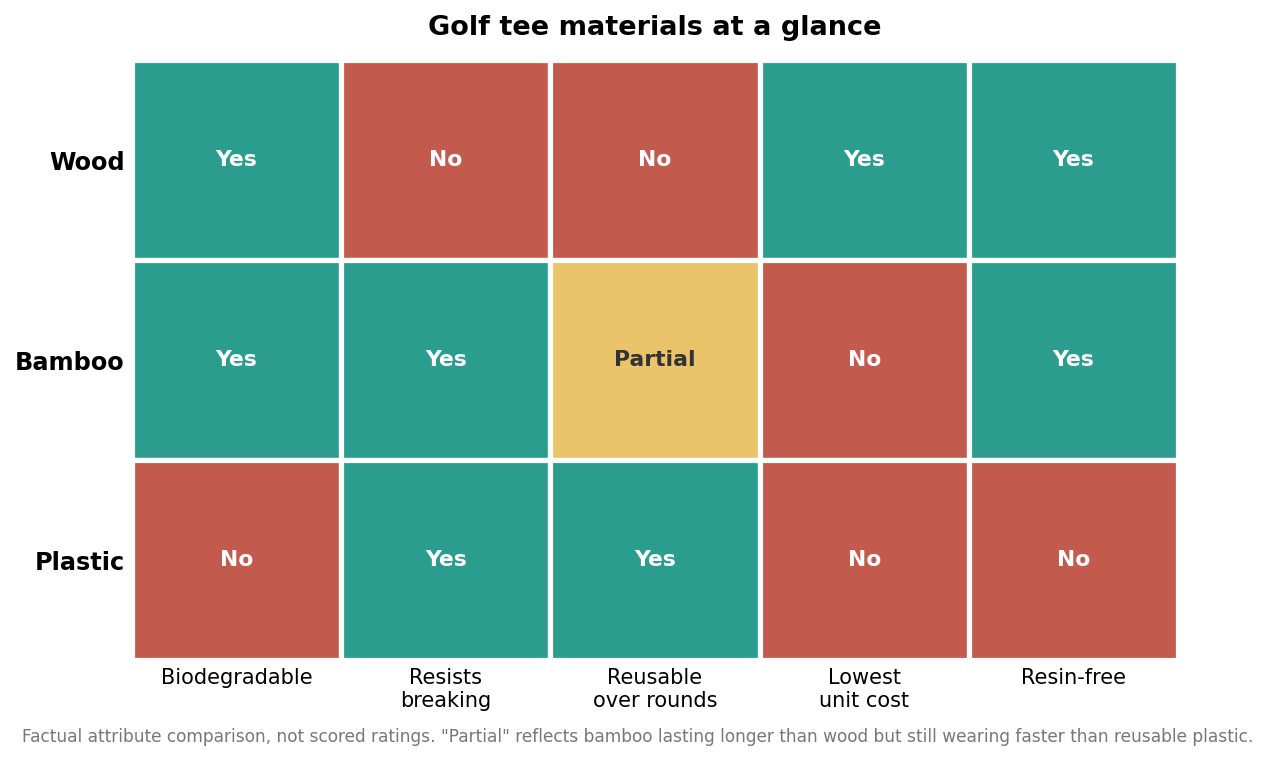
    It sits in the middle on price. Bamboo tees generally cost more per unit than plain wood and less than molded plastic, and they print just as cleanly. For a brand that wants a sustainability message but does not want recipients complaining that the tees shatter, bamboo is usually the sweet spot. The summary below lays the three materials side by side.

    Comparison matrix of wood, bamboo, and plastic golf tees across biodegradability, breakage resistance, reusability, cost, and resin-free
    How the three tee materials compare across the attributes that matter for a branded bulk order.

    Plastic tees: durable and reusable, with a footprint

    Molded plastic tees are the most durable and the most reusable, surviving many rounds and often built into performance shapes — pronged tops, brush tips, or low-friction designs meant to reduce contact with the ball. If longevity and a premium, engineered feel are the point, plastic delivers, and a single plastic tee can outlast a whole handful of wooden ones.

    The trade-off is environmental. Plastic tees are made with resin and do not biodegrade, so they linger on the course, and broken ones get chewed up by mowing equipment, which is why some courses actively discourage them. They also carry the highest unit cost of the three. For a durable, reusable branded tee where the recipient keeps and uses it, plastic makes sense — as long as you are comfortable with the footprint that comes with it.

    Be skeptical of distance claims. Many performance plastic tees are marketed on reduced friction and added yards from low-resistance tips or prongs. Any real-world gain is marginal and debated, so treat those claims as a feel-and-durability feature rather than a guaranteed distance boost, and never let a performance shape push a competition order past what the rules allow.

    Cost versus durability, and which to order

    Line the three up and a clean pattern appears: cost climbs roughly in step with durability. Wood is cheap and short-lived, plastic is pricier and long-lived, and bamboo sits between them while keeping wood’s biodegradable advantage.

    Match the material to the job. For a large one-day giveaway or tournament handout where cost per unit rules and the tees are effectively disposable, wood or bamboo is the call — bamboo if you want the eco message without the breakage complaints. For a premium gift or a performance-minded audience who will reuse the tee, plastic earns its higher price. And if sustainability is central to your brand, bamboo lets you say something genuine about the product without sacrificing much durability.

    Factor breakage into the quantity you order. Because wood snaps most readily, an order of wooden tees should build in a comfortable buffer rather than one tee per expected golfer — extra units cost little at bulk pricing and spare you from running short at an event. Bamboo needs a smaller cushion, and durable plastic the least, so the cheapest material per unit is not always the cheapest way to make sure every player leaves with a usable tee.

    Printing, sizing, and staying within the rules

    All three materials brand well at the common tee sizes, typically the 2¾-inch and 3¼-inch lengths, with the print area being the narrow shaft below the cup — a small canvas that rewards a simple, high-contrast logo over fine detail. Whatever material you choose, keep the artwork bold and legible at that scale rather than cramming in text that will disappear at arm’s length.

    If the tees are for competitive play, stay inside the Rules of Golf. Under Rule 6.2b, a tee may not be longer than 4 inches (101.6mm), and it must not be designed to indicate the line of play or to influence the movement of the ball. Standard wood, bamboo, and plastic tees in normal shapes are conforming, but some novelty or performance plastic designs are not, so if your order is destined for a sanctioned tournament, confirm the tee is on conforming footing before you print several thousand of them.

  • What Length Golf Tee Do You Actually Need?

    What Length Golf Tee Do You Actually Need?

    Tee length is the specification golfers ignore right up until it costs them. Reach into a bag and most players pull whatever tee is nearest, then wonder why the driver feels inconsistent or the iron shot off the tee jumps. The physical length of the peg sets the ceiling on how high the ball can sit, and modern drivers changed what that ceiling needs to be. For anyone buying tees in quantity for an event, a club, or a promotional run, length is also the variable that decides whether one box serves the whole field or half of it goes unused.

    The four standard lengths

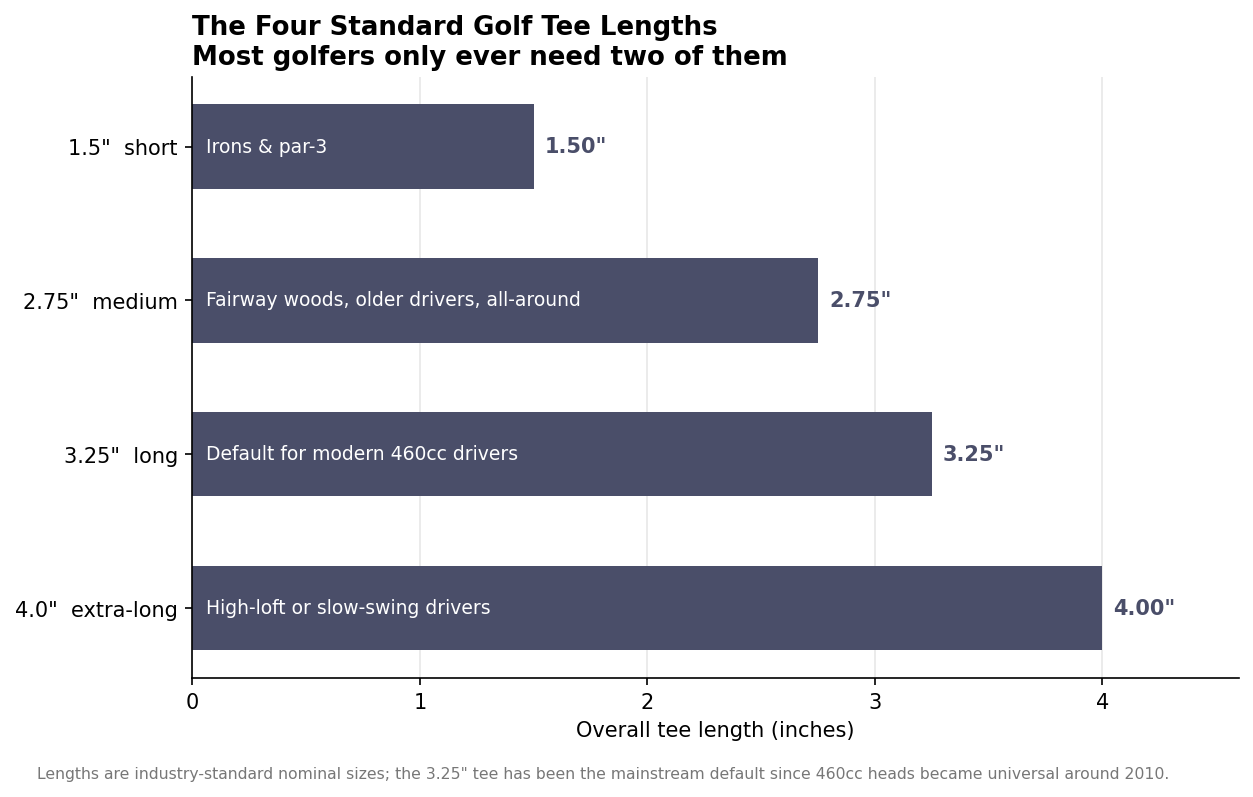
    Tees are sold in a handful of nominal sizes, and knowing what each is for removes most of the guesswork. The 1.5-inch short tee is for irons and par-3 shots, pushed nearly flush so only a dimple or two of the ball clears the turf. The 2.75-inch tee is the versatile middle: it suits fairway woods and hybrids off the tee, older or compact driver heads, and doubles as a passable all-rounder with minor height tweaks. The 3.25-inch tee is the modern default, built for today’s large driver heads and the length most golfers should reach for on a par 4 or 5. The 4-inch extra-long tee is a specialist size for high-loft drivers and slower swing speeds, roughly under 72 miles per hour, where teeing the ball higher helps launch.

    Horizontal bar chart of the four standard golf tee lengths, 1.5, 2.75, 3.25 and 4 inches, with their primary uses
    The four standard tee lengths and what each is built for, from flush iron tees to the extra-long driver tee.

    The practical takeaway from that spread is that most golfers genuinely need only two lengths: a long tee for the driver and a short one for irons and the occasional fairway wood. Everything else is refinement. That is also why a bulk order should not be an even split across all four sizes, a point the stocking section returns to.

    Why the driver decides the length

    Driver head volume is capped at 460cc, and heads have sat at or near that maximum since around 2010. A bigger head has a taller face, and the ball has to be teed higher to strike it on the upswing near the center of the face. The widely used rule is to set the ball so its equator lines up with the top edge of the driver face, which puts roughly half the ball above the crown at address. A quick field check is to push the tee into the ground until only about a thumb’s width of it remains showing; that lands most players close to the right height with a 3.25-inch tee. This is exactly why 3.25 inches overtook the older 2.75 as the standard: the shorter tee simply cannot lift a ball high enough over a 460cc crown without being barely in the ground and unstable. Players with high-loft drivers, very slow swings, or a lot of height often move up to the 4-inch tee for the same reason, more exposed ball.

    Everything that is not the driver

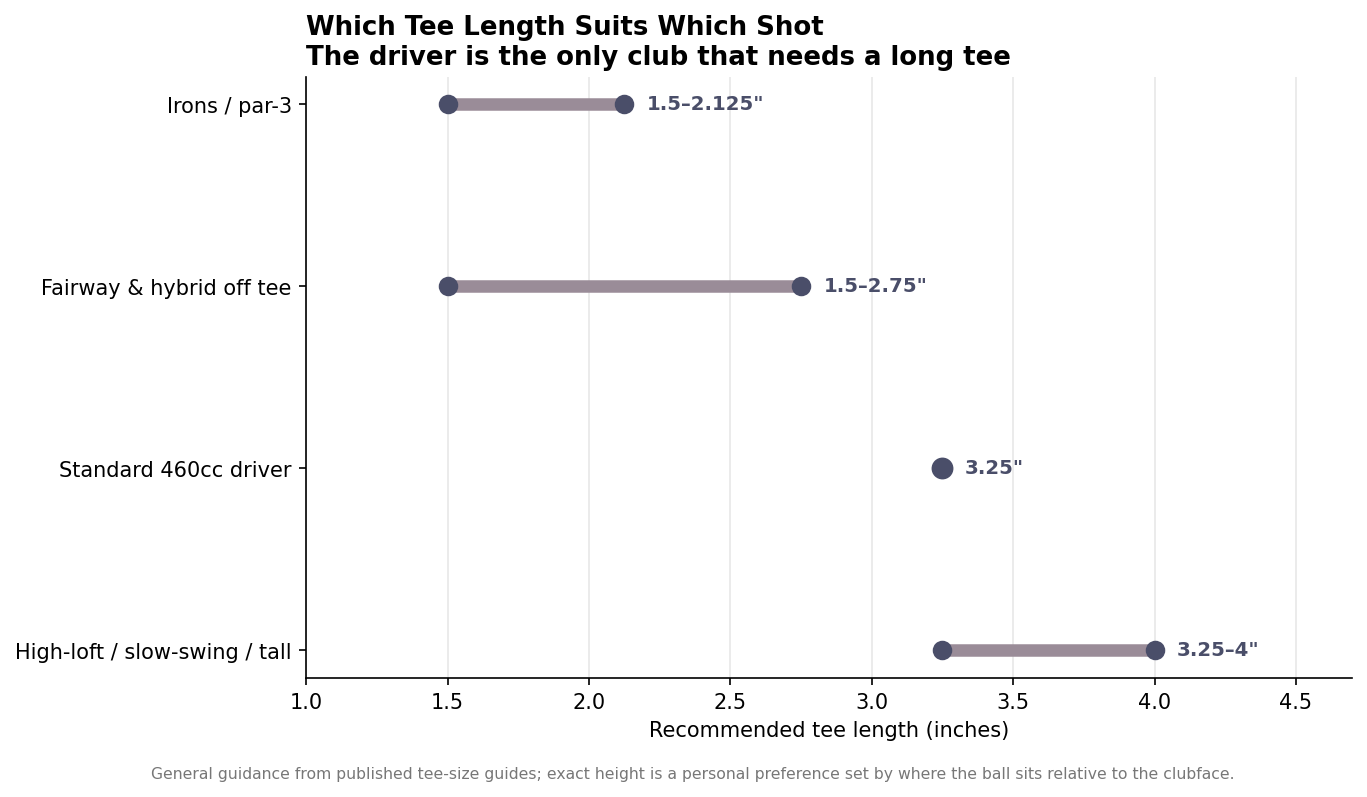
    Away from the driver the priority flips from height to stability, and the tees get shorter. Off the tee with a fairway wood or hybrid, the ball wants to look perched just barely above the grass rather than floating, so a 2.75-inch tee set low, or even a shorter one, does the job. For irons and par-3s, a 1.5-inch tee pressed almost flush gives a clean strike with the ball only a dimple or two off the turf, which mimics a good lie rather than launching the ball. The 2.75-inch tee is the single most versatile length precisely because it can cover fairway woods, hybrids, and, pushed most of the way in, iron shots too, which makes it the natural second size to carry alongside a long driver tee.

    Range chart showing recommended golf tee length by shot type, from short iron tees to long driver tees
    Recommended tee length by shot: only the driver reaches for a long tee, while irons and fairway woods want the ball low.

    None of these are rigid rules. The right height is ultimately personal and set by where the ball sits relative to the face, so the ranges above are starting points a player fine-tunes. But the shape of the guidance holds: only the driver reaches for a long tee, and shorter clubs want the ball low and stable.

    Consistency matters more than the tee itself

    Whatever length a player settles on, the value comes from teeing at the same height every time, because a repeatable ball position is what lets the swing groove. This is where length quietly helps: a tee that is the right length for the club can be pushed to a natural, repeatable depth, while a too-short driver tee has to be left barely gripping the ground to get any height, which makes it wobble and vary shot to shot. Length also interacts with breakage. A long tee under a hard driver swing takes real force at impact, and thin or brittle tees snap, which is both an annoyance and a hidden cost across a large order. Stepping up to a sturdier tee in the correct length, rather than forcing a short or flimsy one to do a job it is not built for, tends to pay off in both consistency and how many tees survive a round. For a group order, that reliability is worth more than trimming the per-tee cost.

    What to stock for a bulk or event order

    For a tournament, a corporate outing, or a pro-shop program, the temptation is to order one length for simplicity, and the mistake is picking the wrong one. The 3.25-inch tee is the workhorse and should make up the bulk of any general order, because it is the one length every driver-swinging player can use and it still functions, pushed deeper, for other clubs in a pinch. If the order only ever includes one size, it should be this one. When budget and logistics allow a second size, add 2.75-inch tees for the iron and fairway-wood crowd and for players who tee low, and keep any 4-inch and short 1.5-inch tees as small specialty quantities rather than core stock. There is also a decoration reason to standardize: the tee shaft is only about 4.7 millimeters across, so the printable band for a logo is narrow and consistent branding is easier when the run is concentrated in one or two lengths rather than scattered across four. Decide the length mix before the artwork, weight it toward the 3.25-inch standard, and the order will fit the field it is meant for.

  • Tee Height: The Cheapest Fix in Golf

    Of all the variables in a golf swing, tee height is the one that is entirely under the player’s control and almost never controlled. Most golfers push the tee in until it feels about right, which means it is different on every hole.

    What tee height actually changes

    With a driver, the goal is to strike the ball slightly above the club’s center on the way up, which produces higher launch and lower spin — distance, in other words. Too low and you hit down on it; too high and you slide under.

    The rule of thumb for a modern large-head driver is that roughly half the ball sits above the crown at address. That is a lot higher than most amateurs tee it, and it is why 83mm tees exist.

    Irons want the opposite

    With an iron the strike is descending, so the ball should sit barely above the turf — just enough to guarantee a clean lie. A 54mm tee pushed most of the way in is right, and a long tee is actively unhelpful.

    This is why carrying one tee length for the whole bag is a compromise, and why splitting an order makes sense.

    Where castle tees come in

    A castle tee has a collar that stops it entering the ground past a fixed point. Push it in as hard as you like and the height is identical every time.

    For a coach that is a teaching aid: it removes one variable so the swing can be worked on. For a player it is repeatability, which is most of what practice is trying to build.

    Color-coding the set

    Four collar heights, four colors, and a player picks the right one at a glance rather than reading a molded number. Low for irons and hybrids, high for the driver, two in between.

    That glanceability is the entire reason to color code, and it is why we do not sell them single-height.

    Ground conditions change everything

    A tee pushed into soft winter turf goes deeper than the same tee in baked summer ground, so even a consistent player gets inconsistent height across a season.

    This is the argument for castle tees that nobody makes and the one most likely to land with a member: it is not about your technique, it is about the ground.

    What to hand out

    For a general club or corporate order: 70mm hardwood or bamboo, because it suits most of the bag. For an academy or a range: a color-coded castle set, because the point is repeatability. For a driver-focused promotion: 83mm, and say why on the pack.

  • Printing a Logo on Something Six Millimeters Wide

    A tee shaft is about six millimeters across and maybe forty long. That is a smaller print area than almost anything else a brand puts a logo on, and artwork designed for a letterhead does not survive it.

    Simplify one level, then one more

    Taglines, registered marks, web addresses and secondary lines do not survive at tee scale. A mark and a short name is the realistic budget, and often the mark alone is stronger.

    The instinct is to shrink the full logo. The right move is to build a reduced version — which we do free — and use it for anything printed this small.

    Stroke weight has a floor

    Below roughly 0.3mm at final size, a printed line either drops out or fills in depending on ink coverage. Fine serifs, hairline rules and thin outlines are the first casualties.

    Thicken strokes deliberately rather than hoping. A slightly heavier mark at tee scale reads as confident, not crude.

    One or two colors, not four

    Each color is a separate pass and each pass introduces registration tolerance. On a curved six-millimeter surface those tolerances stack up fast, and a four-color mark ends up soft at every edge.

    One color, in strong contrast to the tee, outperforms a faithful full-color reproduction every time at this size.

    Tee color is half the contrast equation

    A dark mark on a natural or white tee reads from a distance. The same mark on a mid-tone painted tee can disappear entirely.

    If the tee is painted in a brand color, the mark usually has to be white or black rather than a second brand color. That is a design decision worth making before the run rather than being surprised by.

    Bamboo prints sharper than wood

    Hardwood is open-grained, so ink spreads slightly into the fiber and edges soften. Bamboo is denser and paler, and holds a crisper edge.

    If your mark has any fine detail that has to survive, that alone is a reason to specify bamboo.

    Always proof at actual size

    A logo viewed at 400 percent on a screen tells you nothing. We render every tee mockup at true scale, and it is reliably the moment a customer decides to drop the tagline.

    Ask for the same from anyone else you buy from. It costs nothing and it prevents the most common disappointment in promotional print.

  • The Complete Buyer’s Guide to Custom Golf Tees

    Tees are bought by the tens of thousands on a unit price, and that is precisely why so many of them break. Nothing about a tee is complicated; several things about it are easy to skip.

    This guide covers the four decisions and the one specification nobody asks about.

    Grain direction is the specification nobody asks about

    A wooden tee is a thin shaft under a sharp impact. If the grain runs along its length the tee flexes and recovers. If the grain runs across — which happens when tees are cut economically from board offcuts — it shears at the neck on the first solid strike.

    Ask whether tees are turned from long-grain hardwood. It costs very little more and it is most of the difference between a tee gift that gets used and one that annoys somebody at the first hole.

    Length, and why splitting the order is sensible

    54mm suits iron play and par-three courses. 70mm is the all-round default and what most orders should specify. 83mm is what modern large-head drivers actually want, and a player using a 460cc driver on a 54mm tee is fighting the equipment.

    Splitting an order across two lengths costs nothing extra here, and it is almost always better than guessing one.

    Wood, bamboo or polymer

    Hardwood is the cheapest per tee and entirely adequate when the grain is right. Bamboo costs slightly more, takes noticeably more strikes before breaking, prints sharper because the surface is denser and paler, and carries a genuine three-to-five-year harvest claim.

    Molded polymer lasts dozens of drives and is the only sensible choice for castle tees, performance designs and driving ranges where tees are struck all day. Per round rather than per tee, it is often the cheapest of the three.

    Printing at six millimeters

    A tee shaft is about six millimeters across. Most logos need simplifying to survive that: fine strokes fill in, small text closes up, and a mark with four colors becomes a smudge.

    One or two colors, bold shapes, and a proof at actual scale before the run. We render every tee mockup at true size for exactly this reason, and it is where most designs get cut back.

    Castle tees are a coaching tool, not a novelty

    The molded collar stops the tee going deeper into the ground, so every shot is teed at an identical height. That removes one variable from a swing, which is why academies hand them out and why players who have used them buy more.

    Four color-coded heights cover irons through drivers. Check competition rules if they are for tournament use — the rules bodies are the authority, not us.

    Buy the pack, not the tees

    Loose tees in a bag are a component. Tees with a marker and a divot tool in a printed pack are a tee gift, and the difference in reception is out of all proportion to the cost.

    Have them assembled and sealed. On a field of a hundred and forty, that saves more than it costs, and it is the difference between a calm Friday and a late one.

    What to send us

    Your logo, the material and length you are leaning toward, roughly how many, and whether you want packs assembled. If names go on individual packs, send a spreadsheet with the pairing order too.